



It’s a Masterclass in Suspense, Not Gore
Modern horror often leans on graphic violence to shock audiences, but 'Halloween' builds terror through atmosphere and tension. Carpenter famously made the film on a shoestring budget of around $300,000, forcing creativity over spectacle. The result is
a film that relies on what you don't see. Michael Myers, credited as 'The Shape', is often a fleeting figure in the background or a shadow in a doorway. The film waits almost an hour before the first major kill, using that time to build an unsettling sense of dread and make you invested in the characters. This patient, suspense-driven approach is arguably more terrifying and has a longer-lasting psychological impact than a simple jump scare.
The Menacing Simplicity of 'The Shape'
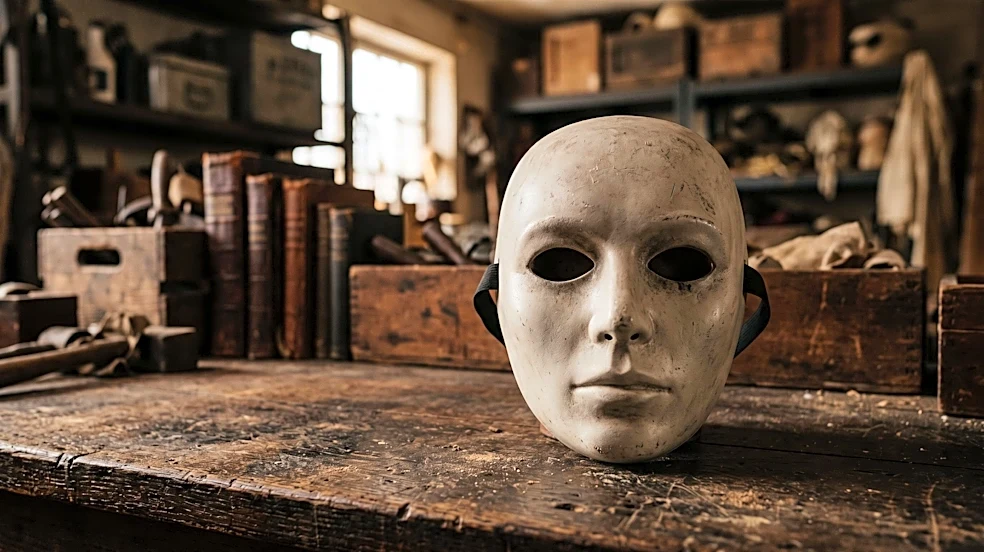
Before elaborate backstories became the norm for villains, Michael Myers was terrifyingly simple: a force of pure, unexplained evil. We know he killed his sister as a child, but the film offers no deeper motive. He is a blank slate, a human-shaped void, which makes him a vessel for our deepest fears. His iconic white mask is famously a modified William Shatner mask, chosen for its pale, featureless quality that unnervingly mimics a human face while being completely devoid of emotion. This lack of a complex 'why' makes him an unstoppable, almost supernatural force of nature, turning the familiar suburban setting into a hunting ground.
The Score Is Its Own Character
Turn off the sound, and 'Halloween' is a creepy thriller. Turn it on, and it becomes a nightmare. John Carpenter, a director and skilled composer, created the score himself in just a few weeks to save money. The main theme, with its iconic and slightly off-kilter 5/4 piano melody, is instantly recognizable and creates a feeling of relentless, impending doom. He used synthesizers, then mostly associated with sci-fi, to craft a soundscape that was revolutionary for the horror genre. Carpenter himself said that when he first screened the film without music for a studio executive, she wasn't scared at all. The score 'saved' the movie, proving that sound can be as terrifying as any visual.
Groundbreaking Cinematography That Puts You in the Killer's Shoes
From its opening moments, 'Halloween' establishes a voyeuristic and deeply unsettling tone. The film opens with a lengthy, continuous point-of-view shot from the perspective of a young Michael Myers, putting the audience behind the mask. This was achieved using the Panaglide camera stabilizer, a new technology at the time that allowed for smooth, floating tracking shots. Cinematographer Dean Cundey used this technology throughout the film, making the camera feel like a predator stalking its prey through the quiet streets of Haddonfield. This technique makes the viewer an unwilling accomplice and heightens the sense of vulnerability, a trick that countless slasher films would later imitate.
It Gave Us the Archetypal 'Final Girl'
While other films had lone survivors, 'Halloween' perfected the 'Final Girl' archetype with Laurie Strode, played by a then-unknown Jamie Lee Curtis. Laurie is intelligent, resourceful, and responsible—a stark contrast to her more carefree friends. While her friends are distracted, Laurie is the one who notices something is wrong. Her survival isn't just luck; it's earned through her observation and her will to fight back, turning everyday objects like knitting needles and coat hangers into defensive weapons. Laurie Strode set the gold standard for horror heroines, creating a trope that would be celebrated, deconstructed, and emulated for decades to come.