







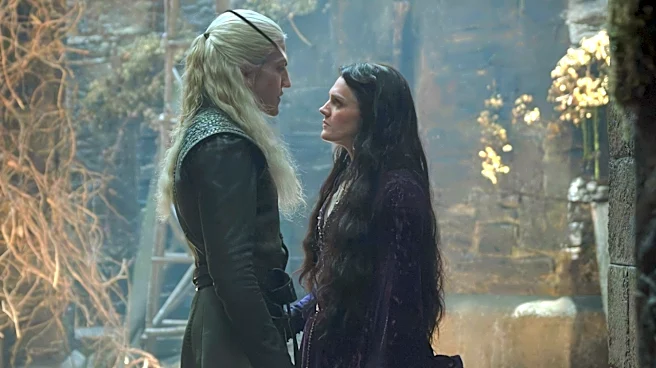
From Childhood Friend to Political Pawn
Before the green dress and the bitter rivalry, Alicent was simply Rhaenyra Targaryen’s best friend. As young girls in the Red Keep, their bond was genuine. But in a court ruled by men, their friendship was a luxury they couldn't afford. After Queen Aemma’s
death, Alicent's father, Otto Hightower, saw an opportunity. He pushed his young daughter into the grieving King Viserys’s path, transforming her from a companion into a consort. This act, born of her father's ambition, not her own, set the stage for Alicent's lifelong conflict: the clash between her own desires, her duty to her family, and the expectations of the realm. She was never raised to rule, but she was thrust into the center of power, forced to play a game where she didn't know the rules.
The Queen Who Followed the Rules
As Rhaenyra defied convention, Alicent clung to it. She became a paragon of the values she was taught: faith, family, and duty. While Rhaenyra carved out a life of relative freedom, Alicent was confined by her role as queen and mother, a position she took with solemn seriousness. This divergence created a chasm between them. Alicent, who sacrificed her youth and personal freedom for the stability of the crown, grew to resent Rhaenyra’s perceived recklessness. This self-righteousness, however, was a shield. Olivia Cooke plays her not as a one-dimensional zealot, but as a woman deeply insecure in her position, using the rules of society to validate her own difficult choices. Her strict adherence to tradition became her only source of power in a world that granted her none formally.
A Tragic Misunderstanding Ignites a War
The true tragedy of Alicent’s arc is that she almost prevented the war. In the years before Viserys’s death, there were moments of reconciliation, glimmers of the friendship she once shared with Rhaenyra. However, the turning point came on the king’s deathbed. His final, delirious words about Aegon's prophecy were misinterpreted by Alicent as a command to place her son, Aegon, on the Iron Throne instead of Rhaenyra. While the books portray her as a more ambitious and calculating figure, the show gives us a woman acting on what she tragically believes to be her husband’s dying wish. This decision wasn't born of pure ambition, but of a misguided sense of loyalty and piety. She genuinely believed she was fulfilling her duty to her king and protecting the realm from the instability she thought Rhaenyra’s rule would bring.
The Weight of a Crown She Never Wanted
Once the war begins, Alicent is confronted with the horrifying consequences of her choices. The death of Lucerys Velaryon at the hands of her son Aemond was not a victory she celebrated; it was a devastating blow that she knew made peace impossible. Throughout Season 2, we see a queen disillusioned with the very conflict she helped start. She is pushed aside by the more bloodthirsty men in her own council, including her son Aemond and Criston Cole. Her attempts to find a diplomatic solution or show mercy are often dismissed. She is horrified by the violence and finds herself isolated, realizing that the 'greens' she leads are driven by a thirst for power she doesn't fully share. She wanted to protect her children; instead, she unleashed a force that threatens to consume them all.
Cooke's Masterclass in Moral Complexity
None of this complexity would land without Olivia Cooke’s masterful performance. She portrays Alicent as a woman perpetually on the verge of a panic attack, her anxiety simmering just beneath a veneer of regal composure. In interviews, Cooke has spoken about not wanting to play a universally liked character, embracing Alicent's flaws and complexities. She infuses Alicent with a deep well of regret and empathy, often communicating more with a haunted stare or a trembling hand than with pages of dialogue. It is Cooke who makes us believe that Alicent still loves Rhaenyra, even as she moves against her. It is her performance that makes Alicent's hypocrisy—like her pious judgment of others while engaging in a secret affair with Criston Cole—feel less like a simple flaw and more like the desperate act of a repressed woman.