








More Than a Game
To understand the two most famous goals in soccer history, you have to understand that Argentina vs. England in 1986 was never just about soccer. Played in Mexico City’s imposing Estadio Azteca, the match was freighted with the political tension of the Falklands
War, a brief but brutal conflict fought just four years earlier. For Argentina, this was more than a chance to advance to the World Cup semifinals; it was a chance at symbolic revenge. Maradona himself later admitted the team felt they were representing a nation still wounded by the war. The atmosphere was a powder keg of national pride, sporting rivalry, and historical grievance waiting for a spark.
The Hand of God
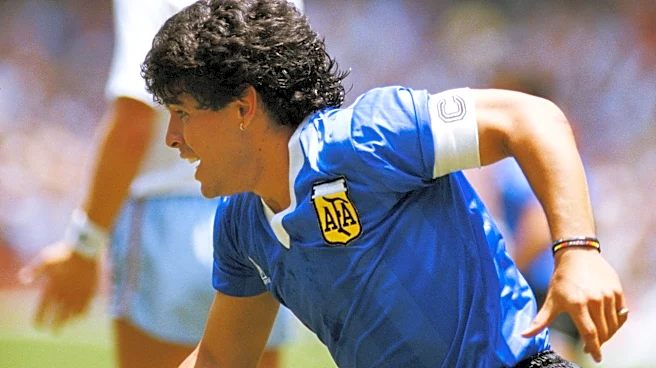
The spark came six minutes into the second half. Following a mis-hit clearance from England midfielder Steve Hodge, the ball looped high into the penalty area. The 5-foot-5 Maradona challenged England’s towering 6-foot-1 goalkeeper, Peter Shilton. As Shilton reached to punch the ball clear, Maradona leapt with him, beat him to it, and sent the ball into the net. The English players furiously protested, pointing to their hands. They saw what the referee, Ali Bin Nasser, and his linesman did not: Maradona hadn’t headed the ball. He had punched it in with his left fist. In the post-match interview, Maradona cheekily claimed the goal was scored "a little with the head of Maradona and a little with the hand of God." The name stuck, immortalizing an act of supreme, illegal cunning.
The Goal of the Century
The English protests were still ringing in the air when, just four minutes later, Maradona delivered his divine rebuttal. Receiving the ball deep inside his own half, he set off on a 60-yard, 11-second journey into legend. He pirouetted away from two defenders, then accelerated, a blur of motion with the ball seemingly glued to his left foot. He weaved past Peter Reid, slalomed around Terry Butcher, skipped past Terry Fenwick, and drew the keeper, Shilton, off his line. With a final, delicate feint, he sat Shilton down and rolled the ball into the empty net. While his first goal was an act of deception, this was pure, unadulterated genius. In 2002, a FIFA poll voted it the “Goal of the Century.” It was a masterpiece that stood in stark, brilliant contrast to the crime that preceded it.
A Legacy in Four Minutes
Argentina won the match 2-1, with Gary Lineker scoring a late goal for England, and went on to win the World Cup. But the story of that day remains the story of Maradona's two goals. Together, they represent the perfect paradox of his career. He was a player who could bend the rules to his will and, moments later, bend the game itself with a display of breathtaking skill that defied belief. For England, it was a robbery followed by a masterpiece. For Argentina, it was a glorious victory, a moment of national catharsis delivered by their flawed hero. The debate over the “Hand of God” continues, but its place in history is secure. It’s the goal that still feels illegal because it was, and the one that reminds us that in sports, as in life, genius and infamy often walk hand in hand.