





The Unending Talent Factory
Imagine the New York Yankees having so many All-Star pitchers they have to send a Cy Young candidate to the bullpen, or the Golden State Warriors leaving a healthy Steph Curry on the bench in the NBA Finals. That’s the reality for France. The nation has
become a seemingly infinite conveyor belt of world-class soccer talent. For every Kylian Mbappé, there’s an Ousmane Dembélé, a Kingsley Coman, or a Randal Kolo Muani—elite forwards at powerhouse European clubs who are often forced to compete for a single spot, or even just a place on the bench. This isn't just about the attack. At every position, France has multiple players who would be the undisputed star of almost any other national team. Think of defenders like Ibrahima Konaté (Liverpool) and Dayot Upamecano (Bayern Munich) battling for playing time, or a midfield so stacked that a player like Aurélien Tchouaméni, a starter for Real Madrid, has intense competition. This isn't a deep bench; it's a second and sometimes third team that could legitimately compete for a World Cup trophy on its own. While other countries pray for one superstar to emerge, France has to figure out what to do with ten of them.
The Coach’s Golden Cage
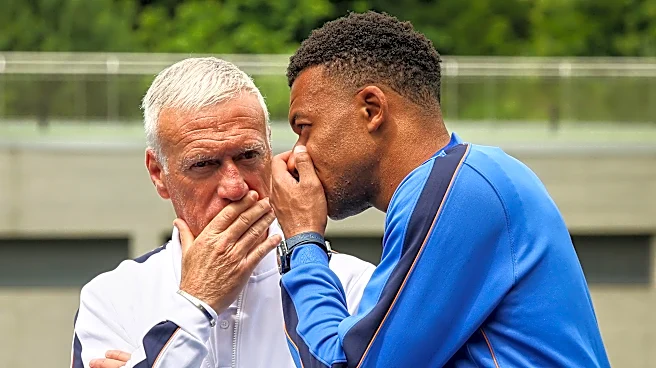
For manager Didier Deschamps, this situation is a blessing and a curse—a golden cage. Every squad selection is a political minefield. When he calls up 26 players for a tournament like the World Cup or the Euros, the French media and public don't just scrutinize who is on the list, but who was left off. Leaving out a fan favorite or a player in red-hot form for his club can trigger weeks of national debate and accusations of bias or tactical ignorance. Once the tournament begins, the pressure intensifies. Every substitution is second-guessed. Why didn't he bring on the faster winger? Why is he sticking with a player who's having a quiet game when a global star is sitting on the bench? Unlike a coach of a smaller nation who has a clear starting eleven and few alternatives, Deschamps’ choices are almost infinite. This creates a constant, draining justification cycle. His job is less about finding talent and more about managing egos, balancing player roles, and making impossible choices that will inevitably leave multi-million dollar athletes and their vocal supporters deeply unhappy.
Chemistry vs. a Collection of Stars
As any fantasy sports player knows, simply assembling the best individual players doesn't guarantee a championship. Team chemistry, defined roles, and individual sacrifice are the invisible ingredients of success. This is France's central challenge. Nearly every player on the roster is the main man at his club—the go-to goalscorer, the midfield engine, the defensive rock. When they put on the French jersey, they are suddenly asked to be a role player, to track back on defense, or to make the simple pass instead of taking the heroic shot. This can create friction. France's shocking exit from Euro 2020 at the hands of Switzerland is often cited as a prime example of this dynamic failing. Despite being the reigning world champions and overwhelming favorites, the team appeared disjointed and rife with internal squabbles. In contrast, their run to the 2018 World Cup title and the 2022 final was built on stars like Antoine Griezmann and Olivier Giroud accepting less glamorous, more team-oriented roles. France’s success depends entirely on whether Deschamps can convince a squad of headliners to perform like a disciplined ensemble cast.
The Crushing Weight of the 'Favorite' Tag
This overwhelming depth automatically positions France as a top contender, if not the outright favorite, in every tournament they enter. This creates a psychological burden that is fundamentally different from that of an underdog. For a team like Morocco in the 2022 World Cup, every knockout round victory was a joyous, historic achievement. For France, anything less than a trip to the final is often framed as a national failure. There is no moral victory, no 'happy to be here.' The expectation is not just to compete, but to dominate. This 'championship or bust' mentality means there is zero margin for error. A single loss in the knockout stage isn’t just a disappointment; it’s a catastrophe that sparks public outcry and inquests. The pressure comes not from a place of hope, but from a place of entitlement born from their incredible talent pool. While other nations dream of what could be, France is haunted by what *should* be, and that is a uniquely taxing form of pressure to carry.