




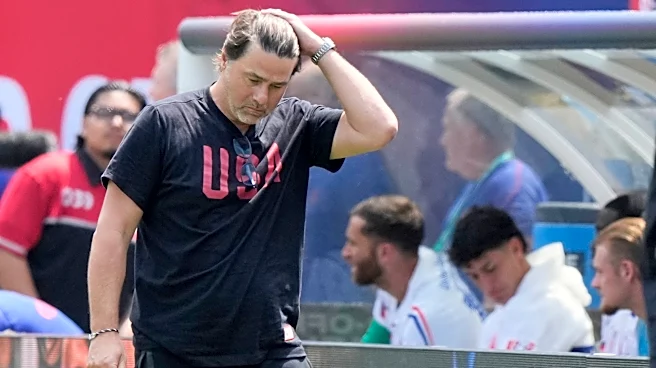




The Anatomy of a National Trauma
A penalty shootout isn’t just a test of skill; it's a test of nerve, magnified by decades of national hope and despair. After 120 minutes of grueling, tactical soccer, the game’s outcome is reduced to a series of individual duels between a shooter and a goalkeeper.
The collective effort of the team vanishes, replaced by a singular, intense spotlight. For fans and media, it feels like a lottery. For players, it’s a high-stakes exam for which the textbook is written by ghosts. This is where history lives. A country doesn’t just remember a missed penalty; it internalizes it. That single kick becomes a cultural shorthand for failure, a wound that reopens every time a new team faces the same fate.
Exhibit A: The English Curse
For the ultimate case study, look no further than England. The nation's shootout trauma began at the 1990 World Cup, with gut-wrenching semifinal misses against West Germany. That loss set a precedent. Six years later, on home soil at Euro '96, Gareth Southgate’s saved penalty in another semifinal against Germany cemented the narrative: England couldn't win from the spot. The failures piled up in major tournaments in 1998, 2004, 2006, and 2012. It became a self-fulfilling prophecy. Every time England entered extra time in a knockout match, the national conversation wasn't about tactics; it was about the impending, inevitable doom. Young players who weren't even born in 1990 inherited the psychological baggage, facing questions from the media and carrying the weight of a nation’s fatalism on their shoulders as they walked to the penalty spot.
The Psychology of the Choke
This isn’t just superstition; it's rooted in sports psychology. When the pressure becomes immense, athletes can experience what’s known as “paralysis by analysis.” Instead of relying on muscle memory honed over thousands of hours, the conscious brain takes over. The simple act of kicking a ball becomes a complex cognitive task. Thoughts of the consequences—letting down your team, your country, becoming the next national scapegoat—flood the mind. This cognitive interference disrupts motor skills. When a team has a history of shootout losses, that external narrative amplifies the internal pressure. Players aren't just trying to score a goal; they're trying not to become the next chapter in a familiar, tragic story. The goal seems to shrink, and the goalkeeper looks like a giant.
How to Break the Vicious Cycle
So how does a team exorcise its demons? The answer lies in confronting the narrative head-on. Before the 2018 World Cup, England manager Gareth Southgate—the man who missed the infamous penalty in '96—revolutionized his team's approach. He didn't ignore the past; he used it. The team underwent detailed psychological profiling, practiced penalties meticulously after grueling training sessions to simulate fatigue, and developed clear, repeatable routines. Southgate framed it not as a game of chance, but as a trainable skill. By owning the history and preparing for the moment with scientific rigor, he gave his players a new script. When England faced Colombia in a shootout, they were prepared. They won, breaking a 22-year curse. This is the model for any “new” team—whether an expansion club or a national side trying to forge a new identity. The past doesn’t have to be a burden; it can be the motivation for meticulous preparation.