




The Universe’s Most Terrifying Commute
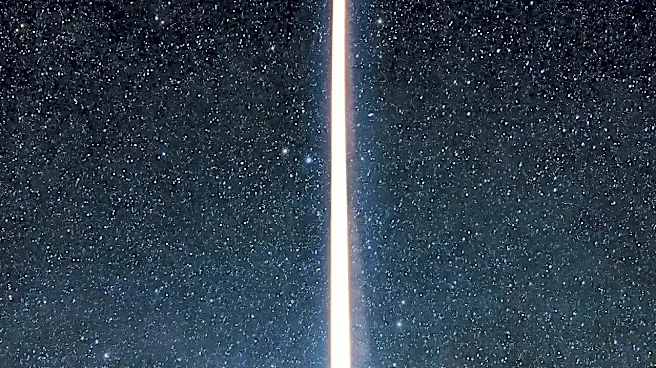
First, a quick refresher for those who haven’t visited the Tau Ceti system recently. The Petrova Line, named after its fictional discoverer Dr. Irina Petrova, is the visible trail left by a single-celled organism called Astrophage. These “star eaters”
are at the heart of the novel's central crisis: they absorb immense energy from a star, causing it to dim, and then travel to a nearby planet to reproduce. In our solar system, they slurp up energy from the Sun and then commute to Venus, which is rich in the carbon dioxide they need to breed. The Petrova Line is the faint infrared glow emitted by trillions of these tiny lifeforms making that interplanetary journey. It’s not a structure, but a traffic corridor—a highway of microscopic aliens that are slowly killing our sun.
It’s Not Magic, It’s Thermodynamics
What makes Andy Weir's creation so brilliant is that he gives his fictional organism a set of unbreakable internal rules. The core principle of Astrophage is its incredible ability to manage energy. The organism maintains a precise internal temperature. Any excess energy it absorbs—even on the surface of a star—is instantly converted into mass. This elegantly solves the problem of how a microbe could survive such extreme temperatures. When it needs to travel, it converts that stored mass back into energy, propelling itself through space by emitting infrared radiation. This process is so efficient that it creates a specific, detectable infrared signature. The Petrova Line isn't just a random glow; it's the specific byproduct of a lifeform with perfectly efficient, mass-to-energy biological engines.
The Real-World Science It Borrows From
While Astrophage itself is fictional, the concepts that make it feel real are grounded in actual astrophysics. The idea of a lifeform using a star's energy is a creative twist on the Kardashev scale, which classifies civilizations by their energy consumption. More directly, the story plays with fundamental principles of gravity, orbital mechanics, and energy conversion. The Astrophage's journey from the Sun to Venus isn't random; it's a calculated trip between an energy source and a resource-rich planet, much like how real-world tidal forces are governed by the gravitational pull between celestial bodies like the Earth, Moon, and Sun. These forces are a differential effect of gravity, where different parts of a body are pulled unevenly, causing stretching and distortion. While the Petrova Line isn't a tidal phenomenon, its existence relies on the same predictable, physics-based interactions between large celestial objects.
Why This Rule Makes the Story Better
The true genius of the Petrova Line is how it serves the narrative. By establishing a firm set of scientific rules for his alien, Weir turns the problem from a generic monster movie into a complex physics puzzle. Humanity can't just 'fight' the Astrophage; they have to understand its biology, its energy cycle, and the very rules that govern its existence. This elevates the stakes. The solution isn’t a bigger weapon, but a smarter idea. The Petrova Line becomes a clue—a breadcrumb trail that allows scientists to deduce the nature of the threat. It’s a perfect example of how 'hard' science fiction uses constraints to create a more engaging and intellectually satisfying story. The threat isn't just that the sun is dimming; it's that it's dimming according to a set of laws, and the only hope for survival is to figure them out before it’s too late.