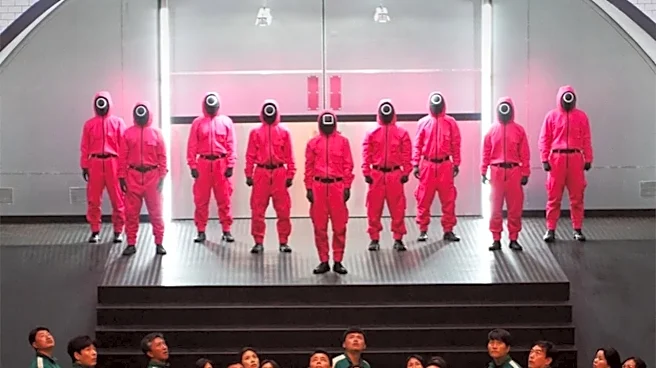








Alice in Borderland
This Japanese series is the most frequent comparison to 'Squid Game', and for good reason. A listless gamer and his friends find themselves in a deserted Tokyo, forced to compete in a series of sadistic games to survive. While 'Squid Game' uses simple
children's games to explore morality, 'Alice in Borderland' leans into more complex, puzzle-like challenges categorized by playing card suits. It trades the explicit critique of capitalism for a more sci-fi mystery, but the life-or-death tension and 'what would you do' scenarios are just as gripping.
The 8 Show
If the social experiment aspect of 'Squid Game' was your favorite part, 'The 8 Show' is your next binge. This Korean drama traps eight contestants in a mysterious building where they earn money for every minute they stay. The catch? The players on higher floors earn exponentially more, creating an intense and immediate class struggle. It’s a more direct and claustrophobic allegory for capitalism, exploring how inequality breeds resentment and cruelty, even when everyone is technically 'in it together'.
3%
This Brazilian dystopian thriller presents a world sharply divided between an impoverished Inland and a utopian Offshore. Each year, 20-year-olds get one chance to endure 'The Process'—a series of intense and sometimes deadly tests—for a chance to join the elite 3% who live in paradise. It shares 'Squid Game's' core theme of desperate people competing for a chance at a better life, all while questioning the very definition of a merit-based society.
Severance
While there are no death games here, 'Severance' captures the same sense of psychological dread and corporate dehumanization. Employees at the mysterious Lumon Industries undergo a procedure that surgically divides their work memories from their personal lives. This creates an unsettling thriller where the 'innies' are essentially prisoners in a sterile, cult-like office, fighting a system they don't understand. If you were fascinated by the loss of identity and rebellion against an all-powerful, faceless organization, 'Severance' delivers that tension in spades.
Hellbound
From the director of 'Train to Busan', 'Hellbound' dials up the supernatural horror. Out of nowhere, otherworldly beings appear to condemn people to Hell, with giant, monstrous creatures carrying out the sentence publicly and brutally. The series isn't about a game, but it explores the societal breakdown that follows. It powerfully critiques how fear, media, and religious fanaticism can create a system of control as terrifying as any game master's, forcing characters to navigate a world where morality has been violently upended.
Sweet Home
For those who appreciated the confined horror and desperate alliances of 'Squid Game', 'Sweet Home' is a perfect fit. This Korean apocalyptic series follows the residents of an apartment building who are trapped inside as humanity begins turning into savage monsters. The residents must band together, battling not only the creatures outside but also the paranoia and mistrust within. It’s a gut-wrenching survival story about what happens when societal rules collapse and your neighbor is as dangerous as the monster down the hall.
All of Us Are Dead
Imagine the stakes of 'Squid Game' but with a zombie apocalypse confined to a high school. This Korean series traps students in their school when a zombie virus breaks out, forcing them to use their wits and whatever they can find to survive. It combines coming-of-age drama with relentless, high-stakes action. The constant threat ensures no character is safe, echoing the feeling that any player in 'Squid Game' could be eliminated at any moment.
The Purge (TV Series)
The TV adaptation of 'The Purge' movie franchise expands on its core concept: for one 12-hour period each year, all crime, including murder, is legal. Like 'Squid Game', the show uses its dystopian premise to explore class divides and the thin veneer of civilization. It follows several characters from different walks of life as they try to survive the night, showing how the powerful exploit the event while the vulnerable are left to fend for themselves. The series unpacks the societal 'game' where the rules are explicitly designed to favor the rich and pit everyone else against each other.