







The Allure of the 'Greek' Costume
When we think of an ancient Greek costume, our minds often jump to a familiar, simplified image: a white sheet, a rope belt, and some gold accessories. It’s the go-to for themed parties and Halloween, easy to assemble from a bedsheet and craft store supplies.
The impulse is to focus on signifiers of wealth or status—shiny trim, maybe a plastic helmet for a warrior like Odysseus. But these details are often just noise. An ill-fitting sheet with glued-on ribbon doesn't evoke the epic tales of Homer; it evokes a last-minute costume idea. The real magic, the element that separates a believable hero from a partygoer in a toga, lies in the garment's structure and silhouette. And in ancient Greece, that structure came from draping.
It’s Not a Toga, It’s a Chiton
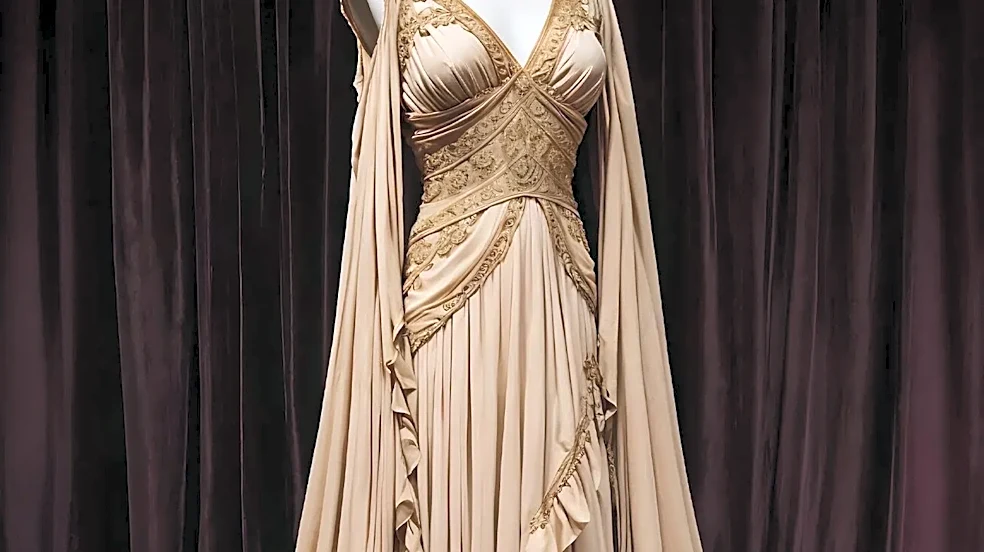
First, a crucial correction: the toga was Roman. The foundational garments of ancient Greece were simpler, more versatile pieces of rectangular cloth called the chiton and the peplos. The peplos, often made of heavier wool, was an early garment pinned at the shoulders. The chiton, typically made of lighter linen, was a tunic worn by both men and women, also fastened at the shoulders and belted at the waist. Neither was elaborately cut or sewn like modern clothes. Their power was in their potential. A single large rectangle of fabric could be a warrior's short, practical tunic, a queen's flowing gown, or a traveler's protective cloak. The entire art was in the wrapping, pinning, and belting. This is the fundamental principle modern costumes often miss.
Fabric Folds Tell a Story
In ancient Greece, the way your clothes hung on your body said everything about you. The draping wasn't just for looks; it was a language. Deep, deliberate folds suggested wealth and leisure, as managing that much fabric required time and care. A philosopher might wear a simple, even worn, cloak to show his disregard for material wealth, while a statesman's perfectly arranged folds conveyed a logical and orderly mind. For a character like Odysseus—king, warrior, and long-suffering traveler—draping can tell his story. His chiton might be shorter for mobility, the fabric weathered, the folds less precise after years at sea. The draping communicates his journey and status far more effectively than a strip of metallic ribbon ever could. The flow of the fabric suggests movement, grace, and purpose, which is why Greek sculptors obsessed over capturing it in marble.
Gold Trim: The Costume Red Herring
This isn't to say ancient Greek clothing was plain. On the contrary, the wealthy wore garments of vibrant color—purple being a particular sign of status—and sometimes featured intricate embroidered patterns. But these embellishments were part of the fabric's essence, not just tacked on. The true sign of luxury was often the fabric itself: its quality, color, and sheer quantity. Piling on cheap, shiny trim is a modern shortcut that misunderstands ancient aesthetics. It’s a costume red herring. Without the proper foundation—a garment that flows and folds with weight and intention—the gold trim just highlights the costume's artificiality. The goal should be to first create an authentic silhouette through draping, which provides the visual and historical foundation. The decoration, if any, should feel earned, not like a first resort.
Getting the Drape Right
So, how do you achieve a better drape? Start with the fabric. A standard bedsheet is often too light and stiff. Look for a heavier fabric that will hang nicely—a light wool, a heavy linen blend, or even a bottom-weight cotton. You'll need a generous amount, a large rectangle that allows for ample folding and blousing over the belt. Instead of sewing, use pins at the shoulders, as the Greeks used decorative brooches called fibulae. Don't be afraid to experiment. Belt it high under the bust, at the natural waist, or low on the hips. Blouse the fabric over the belt to adjust the length—shorter for a man of action, ankle-length for a woman of status. The goal is to create a silhouette that has shape and movement, one that looks lived-in and real.