






The Unseen Conductor in the Control Room
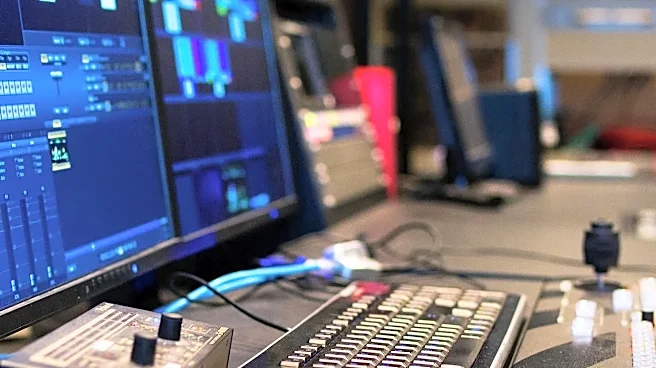
When you’re watching a major live event—the Super Bowl halftime show, an awards ceremony, or a New Year’s Eve broadcast—you’re in the hands of a director you’ll never see. From a dark control room, this person is the visual conductor for an audience of millions.
Surrounded by a wall of monitors showing feeds from dozens of cameras, their job is to make split-second decisions, calling out camera numbers to a technical director who executes the cuts. It's a performance in itself, a frantic and precise dance of communication. The goal is to translate the energy of the live experience into a coherent and exciting narrative for the viewer at home, making them feel like they have the best seat in the house.
The Secret Language of Cutting on Rhythm
“Cutting on rhythm” is the art of timing edits to the beat and energy of what’s happening on screen. In a music performance, the most obvious application is cutting to the beat of the music. A director might switch from a wide shot to a close-up of the drummer precisely on a cymbal crash, or cut from the singer to the guitarist right as a solo begins. This technique injects the visual presentation with the same energy as the audio, creating a powerful, unified experience. But it’s more than just following the music; it's about anticipating the emotional arc of a performance. The director listens and feels, deciding when a lingering close-up on a singer’s face will have more impact than a flurry of fast cuts.
Why Your Brain Doesn’t Get Whiplash
So, with all these rapid cuts, why don't we get visually disoriented or even nauseous? The answer lies in a set of well-established filmmaking rules that live directors follow instinctively. The most important of these is maintaining spatial awareness for the viewer. One key principle is the “180-degree rule.” Directors establish an imaginary line in the scene—for instance, the line between a host and an interviewee—and keep all cameras on one side of it. Crossing that line would make the subjects appear to flip positions on screen, which is incredibly jarring for the brain. This rule creates a consistent geography, so even when cuts are fast, your brain understands where everyone is in relation to each other. Rapid motion and quick cuts can otherwise trigger a visual-vestibular mismatch, where your eyes perceive motion that your inner ear says isn't happening, a primary cause of cybersickness and dizziness.
Matching Action and Giving a Safe Place to Land
Another core technique is “cutting on action.” When a director cuts in the middle of a movement—like a dancer leaping through the air—the viewer’s brain is focused on the action itself, not the edit. The movement flows seamlessly across the cut, making the transition feel invisible. Directors also know the importance of re-orienting the audience. After a rapid sequence of close-ups during a high-energy song, a director will almost always cut back to a wide “safety shot.” This wide view of the entire stage acts as a visual reset, allowing the audience to catch their breath and re-establish the scene's geography before the director dives back into the action. It's a moment of stability amidst the controlled chaos.
The Human Element: Instinct and Preparation
While rules provide a foundation, great live directing is ultimately about feel. A director often knows a song better than the band’s biggest fan, having rehearsed the camera plan for days. They internalize the song's structure, knowing every drum fill and guitar riff by heart. During the live show, they rely on this deep preparation and their own artistic instinct. It becomes less about conscious rule-following and more about a subconscious rhythm, a flow state where they are completely in sync with the performers and the energy of the moment. It’s this blend of meticulous planning and pure gut instinct that separates a competent broadcast from an electrifying one.