



A Director's Vision for Humanity
Director Ron Howard, long known for creating warm and collaborative film sets, was the key to unlocking the film's emotional core. Having worked his way up from child actor to one of Hollywood's most respected directors, Howard possessed a unique understanding
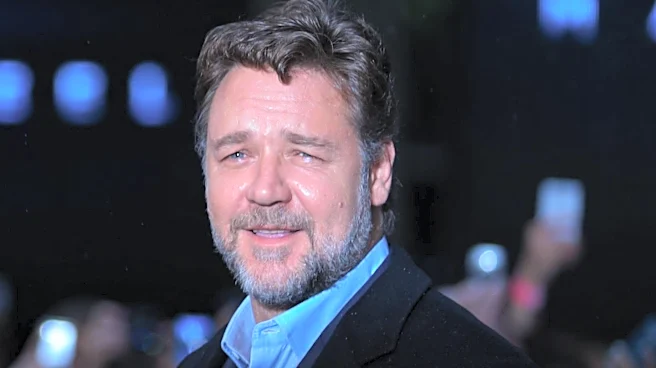
of the actor's process. He was passionate about telling John Nash's story not as a clinical case study of schizophrenia, but as a compelling, human love story. His goal, shared with screenwriter Akiva Goldsman, was to immerse the audience in Nash's subjective reality. This approach required immense trust from the cast, which Howard fostered through meticulous organization and clear communication. At the film's premiere, Russell Crowe emphasized the collaborative energy on set, highlighting the powerful partnership with Howard as a cornerstone of the experience.
The Crowe Method: An Immersive Transformation
At the center of it all was Russell Crowe's towering performance as John Nash. Fresh off an Oscar win for 'Gladiator,' Crowe dove into the role with his signature intensity. He described his first read of the script as a physical experience, immediately knowing he had to do it. With very little visual evidence of what the real John Nash was like as a young man, Crowe had to build the character from the ground up, using intuition and deduction. He met with the real, older John Nash, absorbing what he could, but ultimately had to create a complete character arc that spanned decades. This included nine distinct stages of makeup to reflect Nash's aging process, shot mostly in chronological order to help the performance. The result was a portrayal of genius and struggle so convincing that it became the magnetic force around which the entire production orbited.
An Ensemble Forged in Support
The feeling of 'something special' extended throughout the ensemble cast. Jennifer Connelly, who would win an Academy Award for her role as Alicia Nash, was cast specifically for her powerful on-screen chemistry with Crowe. Unlike Crowe, she chose to meet the real Alicia Nash, wanting to honor her and understand the ferocious, spirited woman who was her husband's salvation. Connelly found the story beautiful and was drawn to the complex, human portrayal of a wife who was far from a one-dimensional, long-suffering figure. Paul Bettany, who played Nash's imaginary roommate Charles, also found a life-changing connection on set, meeting his future wife, Jennifer Connelly, during filming. This genuine warmth and the powerful connections forged between the actors translated into the deeply moving relationships seen on screen, making the film's emotional stakes feel profoundly real.
Crafting a Visual Language for the Mind
One of the film's greatest challenges and triumphs was visualizing a purely internal struggle. How do you show the workings of a brilliant mind descending into paranoid schizophrenia? Howard and Goldsman's script made the audacious choice to present Nash's delusions as reality, only revealing the truth to the audience deep into the film. This allowed viewers to experience the world as Nash did. The crew, from the makeup artists subtly aging Crowe over decades to the mathematicians consulted for the complex equations seen on screen, were all engaged in this central creative challenge. Everyone involved felt they were part of a sensitive, important story worth telling. The dedication to getting the details right, to honoring the 'truth' of Nash's experience even in a fictionalized telling, was a shared mission that elevated the production from a simple biopic to something far more profound.