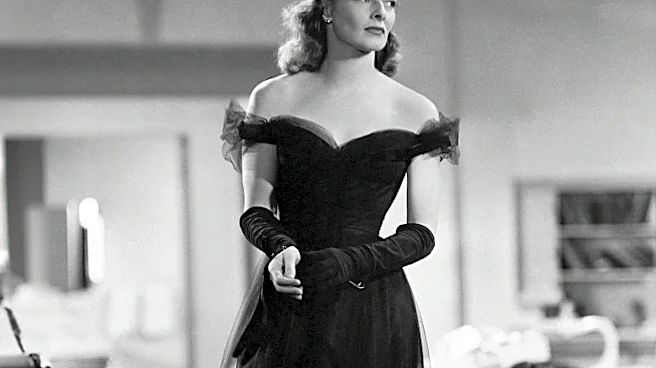

The 1930s: Escapism and Impossible Glamour
The Great Depression was a time of widespread hardship, but you wouldn’t know it from watching the silver screen. This was the era of pure, unadulterated glamour, a deliberate fantasy crafted to help audiences
escape their grim reality. Designers like Adrian at MGM became legends, creating what were essentially dream wardrobes. They favored luxurious fabrics like silk satin and bias-cut gowns that clung to and moved with the body, turning actresses like Jean Harlow and Greta Garbo into otherworldly goddesses. These weren't clothes for real life; they were shimmering, ethereal creations designed for a world where everything was beautiful, a direct and intentional contrast to the world outside the theater.
The 1940s and 50s: Wartime Realism and Structured Conformity
The pendulum swung hard in the other direction. With the arrival of World War II, the decadent fantasy of the '30s became untenable and unpatriotic. Fabric rationing was instituted, and practicality became the new watchword. In film, this translated to more structured, austere silhouettes. Joan Crawford’s famous broad-shouldered look, designed by Adrian, defined the decade—powerful and disciplined, not soft and dreamy. After the war, the 1950s reacted against wartime utility with a new, highly structured femininity, best seen in Christian Dior's "New Look." In Hollywood, designers like Edith Head embraced this, creating costumes that emphasized cinched waists and full skirts—a different kind of fantasy, built on idealized domesticity and prosperity, but still a world away from the free-flowing glamour of the '30s.
The 1960s and 70s: The Gritty Rebellion
If the '50s were about fitting in, the '60s and '70s were about breaking free. A new generation of filmmakers and audiences, fueled by counterculture and a suspicion of authority, had little interest in the polished perfection of the studio era. This was the age of realism. Costumes started to look like actual clothes worn by actual people. The shift was seismic. Think of Theadora Van Runkle’s work on Bonnie and Clyde, which revolutionized fashion by making period clothing feel modern and rebellious. The 1970s doubled down on this grit, with films like Shaft and Taxi Driver showcasing styles born on the street, not in a design studio. Costume designers were no longer just creating glamour; they were documenting culture in all its messy, authentic detail—a direct rejection of the hyper-controlled worlds of the previous decades.
The 1980s and 90s: A Return to Aspirational Fantasy
After a decade of grit and realism, audiences and studios were ready for fun and fantasy again. The 1980s, the era of the blockbuster, reacted against the cynicism of the '70s with a new kind of aspirational flash. This wasn't the ethereal glamour of the '30s, but a bold, materialistic fantasy. Films like Flashdance and Wall Street defined the look of the decade with power suits, big shoulders, and designer labels. The costumes in John Hughes' teen films, often designed by Marilyn Vance, weren't just clothes; they were tribal signifiers and objects of desire. The '90s continued this trend but with a slightly more polished, less cartoonish feel, as seen in the chic wardrobes of films like Pretty Woman. The message was clear: after the '70s made film fashion look like reality, the '80s and '90s decided it should look like a shopping spree.
The 2000s and Beyond: The Great Collapse
In the new millennium, the cycle of reaction hasn't stopped, but it has accelerated and fractured. Instead of reacting to just the previous decade, designers now have the entire history of fashion and film at their fingertips, all the time. The internet and the rise of streaming created an endless visual library to pull from. This has resulted in a postmodern mashup of styles. You get hyper-stylized historical pieces like Sofia Coppola's Marie Antoinette, which uses contemporary aesthetics to comment on the past. You get the global dominance of superhero franchises, which have become our modern-day equivalent of the '30s fantasy spectacle. And you see the constant revival of past decades—'80s neon, '90s grunge, Y2K aesthetics—often all in the same year. The pendulum no longer swings between two poles; it shatters into a thousand pieces, creating a landscape where every era is happening at once.