




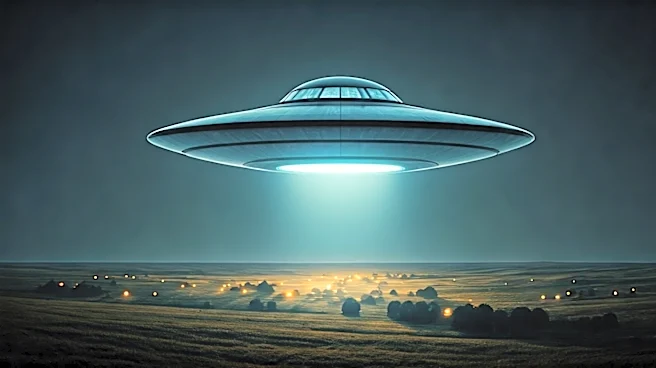


From Flying Saucers to UAPs
Let’s be honest: the official government reports on Unidentified Aerial Phenomena (UAPs) are, by design, a little boring. Filled with technical jargon, blurry videos, and inconclusive findings, they lack the cinematic punch we’ve been conditioned to expect.
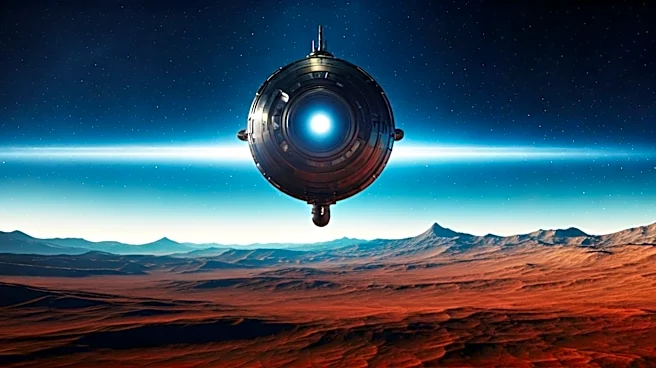
For years, the conversation about 'flying saucers' was relegated to late-night talk radio and dusty corners of the internet. Today, it’s the subject of congressional hearings and Pentagon press briefings. This shift from cultural fringe to national security issue is monumental. Yet, the official narrative is one of caution and data collection, not little green men. The government’s sober assessment of potential sensor malfunctions, foreign adversary drones, or 'other' phenomena is a far cry from the spectacular events we’ve seen on screen. This gap between the dry reality of 'Disclosure Day' and the vibrant world of our collective imagination is where the real story lies. The government may be providing data, but Hollywood provided the soul.
The Two Alien Narratives
When we look to the sky, what are we hoping to see? Pop culture has given us two primary, and profoundly different, answers. The first is the narrative of fear and invasion. Think of the shrieking tripods in *War of the Worlds*, the city-destroying laser in *Independence Day*, or the relentless hunters of the *Alien* franchise. In these stories, 'they' are coming to replace us, conquer us, or consume us. It’s a primal fear of the unknown, a cosmic manifestation of our anxieties about invasion and obsolescence. But there’s another, more hopeful script. This is the story of benevolent, god-like visitors who arrive to save us from ourselves. Steven Spielberg perfected this with both *Close Encounters of the Third Kind* and *E.T. the Extra-Terrestrial*, films that portray aliens as sources of wonder, connection, and spiritual awe. More recently, *Arrival* presented first contact as a mind-bending linguistic puzzle that could unlock humanity’s potential. Any real 'disclosure' forces us to choose: are we living in the prequel to *Independence Day* or the opening act of *Arrival*? Our answer says more about our own optimism or pessimism than it does about any potential visitor.
‘The Truth Is Out There’
Perhaps the most enduring pop-culture lens for viewing any government disclosure is that of the conspiracy thriller. For nine seasons and two movies, *The X-Files* drilled a single, powerful idea into the zeitgeist: 'Trust No One.' The show’s central conflict wasn't between humans and aliens, but between truth-seekers like Fox Mulder and a shadowy government syndicate determined to hide, control, or weaponize the truth. This framework is so powerful that any official report, no matter how transparent, is immediately suspect. If the government says UAPs are just unexplained sensor data, the pop-culture response is, 'That’s exactly what they *would* say.' If they admit to something more profound, the response is, 'What are they still hiding?' This taught skepticism is now a fundamental part of the UFO conversation. Pop culture has created a playbook where the official story is never the real story, making true 'disclosure' an almost impossible concept. We’ve been trained to look for the man behind the curtain, even if there isn’t one.
What We Really Want to Believe
Ultimately, the debate reignited by UAP reports isn't really about extraterrestrial life. It’s about us. Our fascination with UFOs is a mirror reflecting our deepest hopes and fears. The belief in hostile invaders speaks to our anxieties about a world spiraling out of control. The hope for wise saviors speaks to our yearning for guidance, purpose, and a solution to our seemingly intractable problems—climate change, war, division. A world with aliens, for better or worse, is a more interesting one. It makes us special. It gives us a grander, cosmic context. The possibility of contact, even a hypothetical one, forces us to think of ourselves not as Americans, Russians, or Chinese, but as 'humanity.' It’s a unifying concept that we struggle to achieve on our own. We look to the stars for answers, but the questions we're asking are entirely terrestrial.