


The Unblinking Symmetrical Gaze
Peele often places his characters—and his audience—directly in the path of an unblinking stare. He frequently uses tight, symmetrical close-ups where a character looks directly into the lens, forcing a confrontation. The most chilling example is the hypnosis
scene in 'Get Out'. As Missy Armitage stirs her tea, the camera centers on Chris, holding him in a static, perfectly balanced frame. When he enters the "Sunken Place," he is falling into a dark void, but the framing remains direct and suffocating. This technique does more than just create tension; it mimics the feeling of being watched, judged, and pinned down. This directness turns a conversation into an interrogation and a quiet room into a psychological prison. By refusing to look away, Peele forces us to feel the character's paralysis and helplessness.
Suburbia as a Gilded Cage
To Peele, the idyllic American suburb is not a sanctuary but a hunting ground. In both 'Get Out' and 'Us,' pristine, spacious homes become stages for unspeakable acts. Peele and his cinematographers frame these houses with a cold perfection that feels unnatural. The Armitage home in 'Get Out' is a masterclass in this, presented with wide, orderly shots that emphasize its colonial architecture and affluent isolation. It's a space that is theoretically welcoming but feels entirely predatory. Similarly, the Wilson family's vacation home in 'Us' is shot with clean, almost sterile lines, making the eventual invasion by their red-suited doppelgängers feel like a violation of a carefully constructed facade. The horror comes from the realization that the neat lawns and comfortable living rooms are just a thin veneer over a foundation of dread and oppression.
Weaponizing the Wide-Open Space
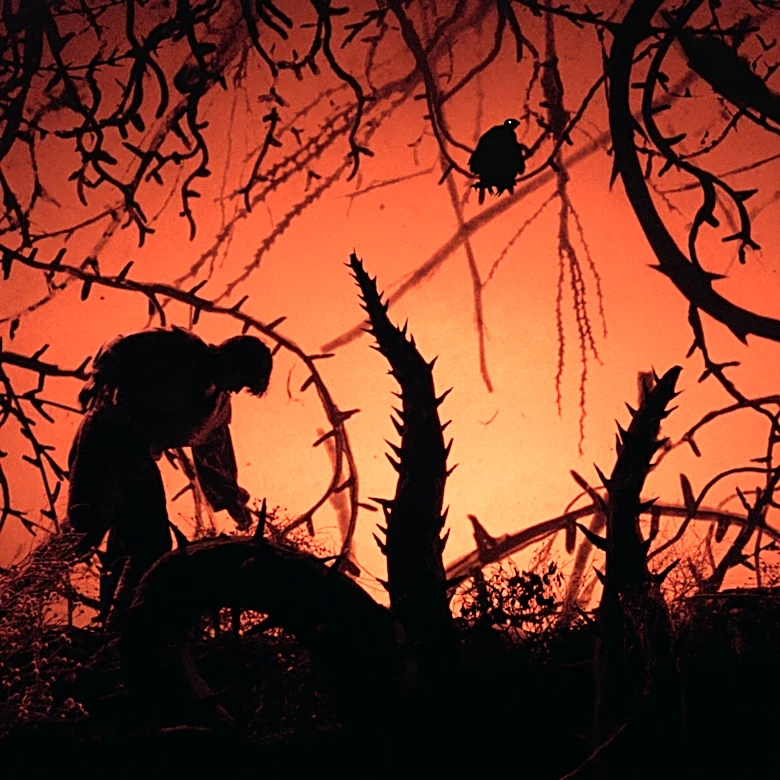
While his first two films found horror in claustrophobia, 'Nope' proves Peele is just as adept at making us fear the exact opposite: vast, empty space. Set on a remote horse ranch, the film weaponizes the expansive desert landscape and the sky itself. Using large-format IMAX cameras, Peele and cinematographer Hoyte van Hoytema create enormous, high-resolution frames where the characters are dwarfed by their surroundings. The horror isn't what’s chasing them through a hallway, but what could be hiding in the clouds above. This use of negative space creates a profound sense of vulnerability. The threat is everywhere and nowhere at once. By turning the big sky—an iconic symbol of freedom in American Westerns—into a source of predatory anxiety, Peele subverts our expectations of where horror can live.
Making Monsters from the Mundane
Ultimately, Peele's genius is his ability to re-contextualize the familiar. A teacup becomes a trigger for hypnosis. A pair of golden scissors transforms from a simple craft tool into a terrifying weapon. A childhood memory of a television show chimpanzee becomes a source of lifelong trauma. Peele’s camera isolates these objects, framing them with an unnerving focus that strips them of their innocence and imbues them with menace. This technique is central to his social commentary; he argues that the real horrors are not supernatural monsters, but the familiar systems, people, and objects we fail to see as threatening. His framing forces a second look, asking us to question the comfort we find in the ordinary and see the terrifying potential lurking just beneath the surface.