






The Movie That Was Also a Business Plan
It’s hard to overstate how revolutionary the original *Toy Story* was in 1995. Beyond its groundbreaking animation, it perfected a business model that Hollywood has been chasing ever since. Most movies hope to sell merchandise as a happy byproduct of
success. *Toy Story* was different. It was a movie *about* toys. Its protagonists were, by their very nature, merchandisable products. The film wasn't just a story; it was the greatest toy commercial ever made. This created a perfect, self-sustaining loop: the movie sells the toys, and the toys’ presence in a child’s bedroom reinforces the movie’s magic. This wasn't an accident. It was the blueprint for a new kind of franchise, where the narrative and the product are one and the same.
The Science of the Sequel Character
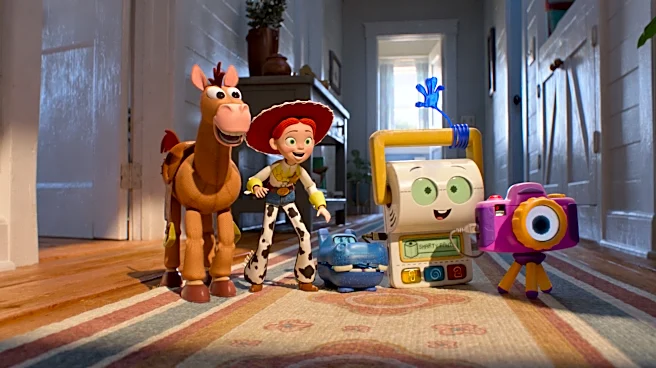
If the first film was the blueprint, the sequels were the laboratory. With each new installment, Pixar’s creators faced a dual challenge: introduce a character that feels emotionally essential to the story *and* looks great on a Target shelf. It’s a delicate art. *Toy Story 2* gave us the instantly classic “Roundup Gang”—Jessie, Bullseye, and Stinky Pete—a vintage-inspired set perfect for collectors. *Toy Story 3* introduced Lotso, a villain whose plush, strawberry-scented design made him both menacing and strangely desirable. But perhaps the most brilliant example came from *Toy Story 4*: Forky. A spork with googly eyes and pipe-cleaner arms, Forky was a stroke of merchandising genius. He was not only central to the film’s theme of what it means to be a toy, but he was also incredibly simple and cheap to manufacture. Even better, he inspired a wave of DIY creativity, letting kids make their *own* official character, deepening their connection to the franchise for the cost of a few craft supplies.
Decoding the Merchandising 'Math'
So, what is the “merchandising math” that will dictate the design of *Toy Story 5*’s new star? It’s a formula with several key variables. First is **Playability**. The character needs an obvious “play pattern.” Duke Caboom, the Evel Knievel-inspired stuntman, is a prime example; his entire existence is built around a wind-up-and-go action feature. Second is **Manufacturability**. The design must be safe, durable, and cost-effective to produce at a massive scale. A character that’s too complex or requires expensive materials might be a non-starter. Third is **Distinct Silhouette and Concept**. The toy must be instantly recognizable, even from a distance. It needs a strong visual hook and a simple, compelling personality that can be explained in a single sentence. Think of the Slinky Dog or the Little Green Men—their forms are their functions. Finally, there's **Franchise Extension**. Does the new character open up new worlds? A space-themed toy could lead to playsets of rocket ships; a fantasy character could inspire a line of castle accessories.
The High-Stakes Bet of Toy Story 5
The pressure on *Toy Story 5* is immense. The franchise is a cornerstone of Disney’s consumer products division, and a new film is expected to inject fresh energy and billions in revenue into the toy ecosystem. But nostalgia can be a trap. The new character can’t just be a variation on a theme. It needs to feel as surprising and inevitable as Forky did. It must capture the imagination of a new generation of kids who have endless entertainment options, while also satisfying the adults who grew up with Woody and Buzz. The design team is likely sorting through hundreds of concepts, testing them against the “math.” Does this character have a memorable voice? A fun gimmick? A compelling emotional arc? And most importantly, will a child see it on screen and immediately say, “I need that”? The answer to that question will determine whether *Toy Story 5* is merely a good movie or a global commercial phenomenon.