




The Stress of Daily Life
The opening of your pocket is a high-traffic area that endures a constant barrage of stress. Every time you slide your hand in, pull out your phone, or clip on a knife or tape measure, you create friction and tension. This small, repeated action concentrates
wear and tear on the pocket’s corners and top edge. Think of it like a path on a lawn; the grass in the middle might be fine, but the edges where people constantly step will wear down first. Unlike the pocket bag, which simply contains items, the opening is a structural gateway that bears the brunt of every entry and exit. Over time, the threads at these entry points simply wear out from the constant rubbing and pulling.
It’s All About the Grain
The real culprit, however, is often invisible: the fabric's grain. Woven fabric has two primary directions: the lengthwise 'warp' threads and the crosswise 'weft' threads. The lengthwise grain, which typically runs parallel to your leg, is the strongest and most stable, with the least amount of stretch. To maximize fabric and achieve a certain look, pocket openings are sometimes cut on the crosswise grain or even on the 'bias' (a 45-degree angle), both of which have more stretch and less stability. This inherent weakness means that when you put pressure on the pocket opening, the fabric is more likely to stretch, distort, and eventually tear. The pocket bag itself, meanwhile, is often made of a different, lighter, but more stably woven material, cut along its stronger grain, making it less susceptible to this type of stress failure.
A Failure of Reinforcement
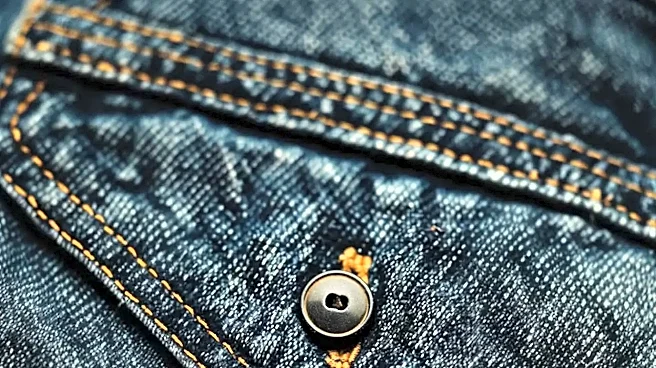
The difference between a pocket that lasts and one that fails often comes down to a tiny, but critical, detail: reinforcement. High-quality jeans and work pants have specific features designed to combat the stress at pocket corners. The most famous is the metal rivet, patented by Jacob Davis and Levi Strauss in 1873 specifically to stop pocket openings from tearing under strain. Another common reinforcement is the 'bar tack'—a dense series of tight stitches that lock the corner down and distribute force over a wider area. These features act as anchors, preventing small tears from starting. In fast-fashion or lower-cost garments, these reinforcement steps may be done poorly or skipped entirely to save money, leaving the stitched corner as the single point of failure. Without a rivet or a robust bar tack, the stress is concentrated on a few threads, which will inevitably break.
The Shape of the Problem
Finally, the very design of the pocket can seal its fate. A sharp, 90-degree corner on a pocket opening creates a natural weak point where forces converge. Any pulling or pressure on the pocket mouth gets funneled directly to that corner stitch. A more rounded or curved pocket opening, by contrast, helps to distribute that stress more evenly along the seam, reducing the likelihood of a single point of failure. While it’s a subtle design choice, the geometry of the pocket opening plays a significant role in its longterm durability. A sharp corner is simply easier to tear than a gentle curve, which is why you'll often see them reinforced with those essential rivets or bar tacks, trying to engineer a solution to a problem created by the design itself.