




1. The 'Swimming' Astronaut
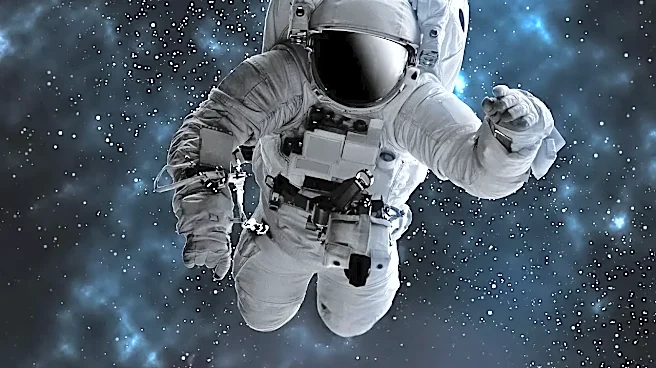
It’s an intuitive mistake: an actor, suspended on wires, tries to move by 'swimming' through the air. But in a vacuum, there’s nothing to push against. As Newton taught us, every action needs an equal and opposite reaction. Real astronauts move by pushing
off a surface, like the wall of their spacecraft. Once they push, they travel in a straight line until they hit something else. Graceful, controlled pushes sell the reality; flailing and 'air-swimming' just looks like someone hanging from a rope, because that’s exactly what it is.
2. Sound in a Silent Vacuum
This is the most common and debated sci-fi sin. Explosions shouldn't go 'boom' in space, and ships shouldn't 'whoosh' by. Sound needs a medium to travel, like air or water, and the vacuum of space has none. While some directors use sound for dramatic effect—a creative choice to convey emotion to the audience—the most powerful scenes often embrace the silence. A film like Gravity masterfully cuts external sounds the moment a character is fully in space, amplifying the sense of isolation and danger with only the sound of their own breathing.
3. Misbehaving Hair and Clothes
In zero-g, long hair doesn't just float elegantly upward like it would underwater. It drifts in every direction, a chaotic halo around an astronaut's head. The same goes for loose clothing or straps. Filmmakers often cheat this for aesthetic reasons, sometimes gelling hair down or simply ignoring it. But when a film gets it right, it’s a subtle detail that adds immense realism. It shows that every single object, no matter how small, is untethered from the familiar pull of gravity we take for granted.
4. Crying Normal Tears
A dramatic moment in space: a single tear rolls down an astronaut's cheek. It’s a powerful image, but it’s physically wrong. On Earth, gravity pulls tears downward. In a microgravity environment, surface tension is the dominant force. Tears would well up and cling to the astronaut's eye and face, forming a liquid blob that wouldn't fall. While it might be a small scientific inaccuracy, getting details like the behavior of liquids right signals a deeper commitment to world-building.
5. Objects Floating Aimlessly… Forever
A pen, a clipboard, a sphere of water—all floating serenely in the middle of a cabin. It’s a classic visual shorthand for 'we’re in space!' The problem arises when these objects remain perfectly suspended for entire scenes without reason. In reality, a spacecraft is a busy, contained environment. Objects are stowed so they don’t become hazards. People and air circulation systems create subtle currents that would cause untethered items to eventually drift and bump into a surface. Constant, static floating is a fantasy; purposeful movement is reality.
6. Forgetting Rotational Physics
This one is a bit more technical but crucial for realism. In many films, when a character is sent spinning, they often slow down for no apparent reason. In the friction-free environment of space, a spinning object will continue to spin at the same rate and on the same axis until an external force is applied to stop it. The same logic applies to moving from one orbiting object to another. You can't just point your ship and fire the thrusters; orbital mechanics are far more complex, involving counterintuitive burns to raise or lower your altitude and speed.
7. The Magical External Force
In a tense scene from Gravity, George Clooney's character unclips his tether and floats away into the void to save his crewmate, seemingly pulled by some mysterious force. But what force? In a stable orbit, with no thrust being applied, there is no external force that would simply pull one astronaut away from another. They would remain in a relatively fixed position to each other. This error is often used as a dramatic device to create sacrifice and peril, but it violates the fundamental principle that an object in motion stays in motion unless acted upon. Without a believable cause, it feels like a cheat.