


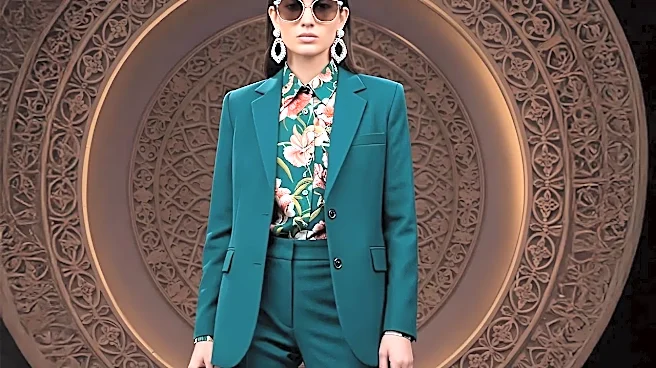


Roberto Cavalli
If any brand can be called the spiritual successor to Gianni's particular brand of Italian maximalism, it's Roberto Cavalli. For decades, Cavalli has been synonymous with a kind of wild, jet-set glamour that feels deeply connected to Versace's own ethos.
Under the creative direction of Fausto Puglisi, that connection is more explicit than ever. Puglisi, a Sicilian designer who reveres Italian craftsmanship, has leaned into the house's most beloved codes: animal prints, sensual silhouettes, and an opulent, more-is-more approach to dressing. His collections often feature the bold prints, devoré velvets, and dramatic cutouts that Cavalli is known for, but with a modern edge that feels both reverent and new. It’s a vision of fashion as a tool for empowerment and freedom, celebrating a woman who dresses for herself and owns her sensuality without apology—a sentiment Gianni would surely have applauded.
Balmain
While Versace celebrated an opulent Italian classicism, Balmain, under Olivier Rousteing, offers a distinctly Parisian take on power dressing. Rousteing has spent over a decade building his “Balmain Army,” a legion of strong, confident women who aren't afraid to be noticed. The aesthetic shares Versace’s love for a strong, architectural silhouette—especially a sharp, powerful shoulder—and a commitment to intricate, couture-level craftsmanship. Where Gianni used baroque prints and the Medusa head, Rousteing uses ornate embroidery, metallic hardware, and richly woven fabrics to create a sense of modern armor. His work is a masterclass in balancing heritage with a hyper-modern, global vision, fusing classic Parisian tailoring with a glamorous, high-voltage energy. It’s less about playful prints and more about sculpted, decorative power.
Mugler
Gianni Versace was a master of celebrating the body, and in the current fashion landscape, no one does that with more architectural precision than Casey Cadwallader at Mugler. Drawing from his background in architecture, Cadwallader has redefined the house with his signature spiral-seamed denim, sheer illusion paneling, and sculptural bodysuits that are both futuristic and ferociously sensual. Like Versace, Mugler champions a powerful and unapologetic femininity. But where Versace's strength came from mythological opulence, Mugler's comes from a sci-fi, cyborgian edge. The look is sharp, graphic, and obsessively constructed, using innovative materials like bonded lycra and technical jersey to create a second-skin effect. It captures the same spirit of empowerment and body-positivity that defined the supermodel era, reinterpreted for a new generation that is just as hungry for boundary-pushing design.
Blumarine
If you love the fun, pop-inflected, and overtly feminine side of Versace, Blumarine is your destination. For years, the brand has been a standard-bearer for a playful, Y2K-adjacent sexiness. Under former creative director Nicola Brognano, it became a viral sensation for its butterfly motifs and candy-colored palettes. With new creative director Walter Chiapponi at the helm since 2024, the brand is entering a new phase. Chiapponi's debut collections have shown a shift towards a more romantic and refined vision, but without losing the brand’s core identity. He's keeping the leopard prints and fun knitwear but grounding them with more sophisticated tailoring and a broader color palette. The result is a brand that still captures a youthful, coquettish spirit that echoes the lighter, more exuberant moments of Gianni's collections—think less of the bondage-wear and more of the vibrant, sun-drenched prints and playful silhouettes.