






First Off, What Exactly Is a 'Bias Cut'?
To understand the bias cut, you first have to think of a piece of woven fabric as a grid. It has lengthwise threads (the warp) and crosswise threads (the weft). Most clothes are cut along these straight grains because it’s stable and uses fabric efficiently.
The bias cut, however, throws that grid out the window. It involves cutting the fabric at a 45-degree angle to those threads. This specific diagonal line is called the 'true bias,' and it's where the fabric has the most natural stretch and flexibility—even in materials with no elastic fibers. Slicing the pattern this way unlocks completely different properties, turning a potentially rigid textile into something fluid and responsive.
The Magic of Drape and Stretch
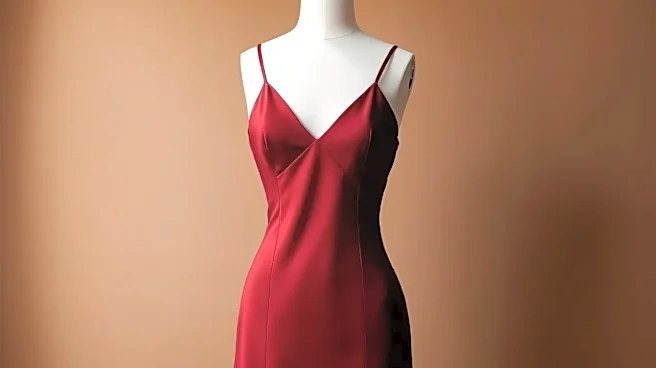
This is where the bias cut truly shines, especially for a slip dress. When fabric is cut on the bias, the threads can shift and slide against each other. This geometric trick gives the fabric a mechanical stretch, often between 15% and 25%, without adding any spandex. Instead of hanging stiffly from the shoulders, the fabric gains a liquid-like quality, allowing it to drape and mold to the body's curves. It skims the figure rather than clinging tightly, creating a silhouette that is both flattering and forgiving. This unique property is why bias-cut slip dresses made of materials like silk or satin seem to move with the wearer, rippling elegantly with every step.
A Revolutionary Idea from the 1920s
The technique was popularized and mastered by French couturier Madeleine Vionnet in the 1920s and 30s. Inspired by ancient Greek statues, Vionnet wanted to free the female form from the rigid corsets of the era. She discovered that cutting on the bias allowed fabric to celebrate the body's natural shape, creating sensual, fluid gowns that moved with the wearer. Her work was revolutionary, transforming fashion and establishing the bias cut as a hallmark of high-end, elegant design. Hollywood's Golden Age quickly adopted the look, and Vionnet's slinky, body-skimming gowns became iconic on stars like Marlene Dietrich and Greta Garbo.
The Trade-Offs: Why Are Bias-Cut Dresses More Expensive?
There's a reason this luxurious fit comes with a higher price tag. First, cutting pattern pieces diagonally is incredibly wasteful, often using 15-25% more fabric than a standard straight-grain layout. The oddly shaped scraps left between the diagonal pattern pieces are often too small to be used. Second, working with bias-cut fabric is a highly skilled and time-consuming process. The fabric is unstable and prone to stretching, warping, and shifting on the cutting table and under the sewing machine. Seamstresses must handle the material with extreme care, often letting it hang for 24 hours to relax before sewing to prevent distortion. This specialized labor adds significantly to the final cost of the garment.
How to Spot a Bias-Cut Garment
Once you know what to look for, identifying a bias-cut dress is straightforward. If the fabric has a visible weave, like in some silks or linens, check the direction of the threads. On a bias-cut dress, the weave will run diagonally at a 45-degree angle to the main seams, rather than straight up and down. Another simple test is to gently pull the fabric. A woven garment cut on the straight grain will have minimal give when pulled horizontally or vertically. A bias-cut piece, however, will have a noticeable stretch when pulled in these directions. This inherent flexibility is the tell-tale sign of a garment designed to drape and flow.