



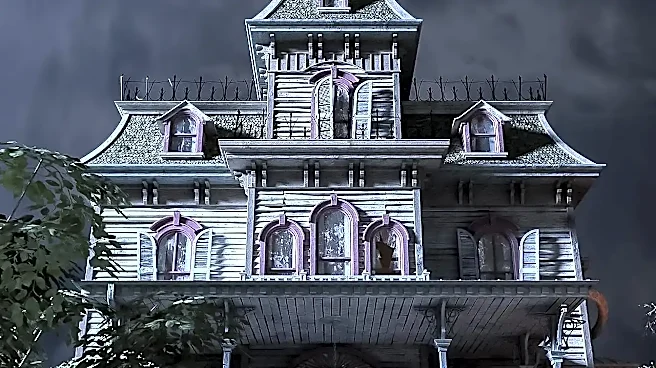

Where Shadows Become Monsters
Long before digital monsters, filmmakers had to create terror with light and its absence. Black-and-white is the perfect medium for this, a lesson taught by the German Expressionists of the 1920s. Films like “The Cabinet of Dr. Caligari” used distorted,
painted sets with harsh, unnatural shadows to create a world that felt fundamentally wrong and oppressive. The style was anti-realistic on purpose, making the environment itself a source of anxiety. Later, this principle was perfected in film noir and horror. In a monochrome world, every darkened corner or elongated shadow isn't just a lack of light; it's a space where your imagination is invited to place the monster. The iconic image of Count Orlok’s shadow ascending the stairs in “Nosferatu” is terrifying not because of what you see, but because the silhouette is a pure, distilled symbol of encroaching doom.
Terror in What You Can't See
Modern horror often leaves little to the imagination. By contrast, classic black-and-white psychological thrillers understand that the unseen is infinitely more frightening than the seen. When color is removed, your focus is forced onto other elements: the subtle shifts in an actor's expression, the unsettling sound design, and the unnerving camera angles. Robert Wise's “The Haunting” (1963) is a masterclass in this, building unbearable tension through bumps in the night and characters' terrified reactions rather than explicit ghosts. Similarly, Jack Clayton's “The Innocents” (1961) uses its pristine, stark black-and-white cinematography to make its grand, empty manor a character in itself. The horror is implied, lurking in the deep focus shots and the ambiguous behavior of its child characters, forcing viewers to question what is real and what is imagined madness.
An Uncanny, Dreamlike World
There's an inherent surreality to a world without color. It's a visual language that immediately separates the film's reality from our own, making it a perfect landscape for fables and nightmares. Charles Laughton’s one and only directorial feature, “The Night of the Hunter” (1955), is perhaps the greatest example of this. It's less a straightforward thriller and more a dark, American fairy tale. Cinematographer Stanley Cortez used high-contrast black-and-white film stock to create a look that feels both beautiful and menacing, like a children's storybook gone horribly wrong. The famous sequence of the children escaping down a river is shot with an artificial, dreamlike quality, where the familiar nature of the Ohio riverbank becomes an alien landscape populated by watching creatures. The lack of color makes the world uncanny and enhances the film’s mythic battle between good and evil.
The Blueprint for Modern Fear
Watching these films isn’t just a history lesson; it's about seeing the DNA of modern horror. The a-monster-is-born hubris of “Frankenstein” (1931), the jump scare perfected in “Cat People” (1942), and the slasher template laid out in “Psycho” (1960) all happened in black and white. These movies didn't just scare audiences; they tapped into deep societal anxieties about science, sexuality, and the other. The giant ants in “Them!” (1954), born of atomic testing, represent a post-war fear of nuclear annihilation. The Gill-man in “Creature from the Black Lagoon” (1954) embodies the terror of the unknown depths and the consequences of disturbing the natural world. These foundational stories prove that effective horror doesn’t need a massive budget or photorealistic viscera. It needs a powerful idea, a compelling atmosphere, and the courage to let the audience’s own fears do the heavy lifting.