





The Age of Spectacle and Tinfoil Hats
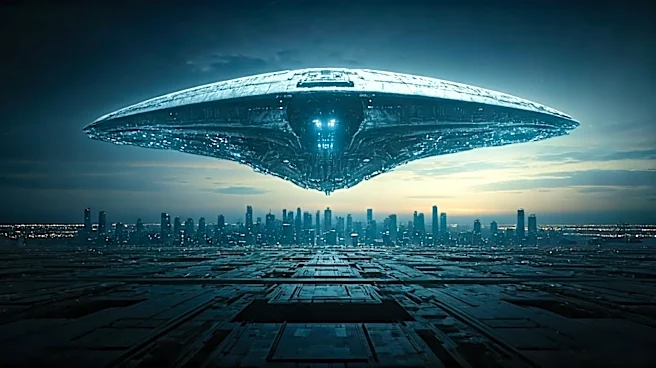
For the past few decades, UFO stories in American culture have largely existed at two extremes. On one end, you had the world-ending blockbuster. Starting with Independence Day in 1996, aliens were synonymous with explosions, vaporized landmarks, and a presidential
speech uniting the globe against a common threat. It was big, loud, and about as subtle as a laser beam to the White House. The focus was on the collective awe and terror of humanity, not the intimate fears of a single family. On the other end was the tinfoil-hat conspiracy thriller, perfectly embodied by The X-Files. Here, the threat wasn't an alien armada but a shadowy government cabal covering up the truth. It was a world of abductions, implants, and whispered warnings in parking garages. While brilliant and deeply influential, it framed the alien encounter as an act of violation and paranoia. In both modes, the wonder and mystery that defined early classics like Close Encounters of the Third Kind felt like a distant memory, replaced by either bombast or dread.
Enter the Grounded Storyteller
Then comes a filmmaker like Jeff Nichols. If you know his work, you know he isn't a blockbuster guy. With films like Take Shelter and Mud, Nichols established himself as a master of American anxiety, telling deeply personal stories about ordinary people—often fathers—grappling with extraordinary circumstances. His characters don't live in gleaming cities; they live in rural Ohio or on the banks of the Mississippi River. Their problems are visceral: a coming storm that might be a delusion, a fugitive who needs protecting, a love that crosses racial lines in a prejudiced world. He’s a director of grit, atmosphere, and intense emotional stakes. So when he decided to make a sci-fi film, it was never going to be about aliens blowing up the Golden Gate Bridge. It was going to be about a family in a beat-up sedan, driving through the night, running on cheap coffee and raw-nerve desperation. He wasn't interested in the invasion; he was interested in the people on the ground looking up.
A 'Midnight Special' Kind of Mystery
Nichols’ 2016 film Midnight Special is the perfect thesis for this new “adult” UFO story. The plot follows a father who has broken his son out of a cult, and the two are now on the run from both the cult and the U.S. government. The reason? The boy has inexplicable powers that seem to have an otherworldly origin. The film plays out like a tense, dusty chase movie, but its core isn't sci-fi action—it's a story about the terror and wonder of parenting. It asks a profound question: What do you do when your child is something more than you can comprehend, and your only job is to protect them long enough for them to find their own way? There are no quippy one-liners or epic dogfights. Instead, there’s the low hum of the car engine, the flicker of fluorescent lights in a cheap motel, and the quiet, awestruck fear in Michael Shannon’s eyes. The film consciously evokes the feeling of early Spielberg—the suburban awe of E.T. or Close Encounters—but filters it through a lens of working-class struggle and parental anxiety. This is what makes it feel adult: the stakes are not the planet’s survival, but a family’s.
Why We Need Adult UFOs Now
This shift in storytelling isn’t happening in a vacuum. Nichols’ approach, also echoed in the cerebral, emotional depth of films like Denis Villeneuve’s Arrival, reflects a culture that is finally ready to discuss the unknown without jumping straight to caricature. For years, public interest in UFOs was a punchline. Today, with credible pilot testimony and declassified government reports, the conversation has become sober and serious. The questions are no longer just “Are they real?” but “What does their existence mean for us?” Our fiction is evolving to meet that maturity. We are less interested in how to fight aliens and more interested in what their presence reveals about our own humanity, our faith, and our ability to connect. The “adult” UFO story uses the alien as a catalyst for introspection. It suggests that the most profound encounter isn't with a spaceship, but with the people we're trying to protect in a world that feels increasingly uncertain and strange.