






The Mechanical Marvel
Our journey begins not with a biological alien, but a mechanical one: Robby the Robot from the 1956 classic Forbidden Planet. While technically a human creation, Robby was built using knowledge from the hyper-advanced, long-extinct Krell race. He represents
the earliest form of the helpful “other.” Robby is a walking, talking Swiss Army knife with a charming, dry wit. He can synthesize anything from whiskey to new dresses, but his core programming, much like Isaac Asimov's Laws of Robotics, forbids him from harming humans. In the film, which is a sci-fi retelling of Shakespeare's The Tempest, Robby is analogous to the spirit Ariel—a powerful but ultimately subservient entity bound to his master. He is a brilliant creation but fundamentally an appliance, a reflection of a post-war era fascinated by technology but viewing it as a tool to be controlled.
The Loyal Sidekick
By the 1960s and 70s, the alien companion had evolved into something more familiar: the loyal sidekick. Think of Star Trek's Mr. Spock or Star Wars' Chewbacca. These characters weren't tools; they were friends and crewmates with distinct personalities. Spock, the half-Vulcan science officer, became a cultural icon. His constant struggle between human emotion and Vulcan logic provided a perfect foil to Captain Kirk's passionate impulsiveness. He was an outsider offering a unique perspective, but his identity was largely defined by his role on a human-led crew. Similarly, Chewbacca is the ultimate co-pilot and protector. His growls and roars, understood only by Han Solo, underscore his otherness, while his unwavering loyalty makes him family. These companions are beloved and indispensable, but they exist in orbit of the human protagonists, supporting their journey rather than co-creating it.
The Empathetic Enigma
The next major shift brought us aliens who were less about utility or logic and more about pure empathy and wonder. Steven Spielberg's E.T. the Extra-Terrestrial is the quintessential example, presenting an alien who is vulnerable, childlike, and communicates through feelings. The focus isn't on what E.T. can do, but on what he makes us feel. A more modern version of this archetype is Groot from Guardians of the Galaxy. While immensely powerful, his personality is gentle, loyal, and conveyed almost entirely through the phrase, "I am Groot." Like E.T., Groot functions as the heart of his found family. His most defining moment is one of self-sacrifice, born of love for his friends. These companions act as moral compasses, reminding humanity (and the audience) of the power of innocence, friendship, and connection beyond language.
The True Peer
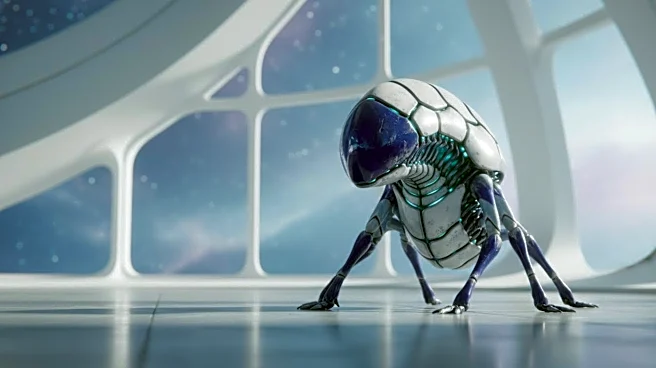
This brings us to the modern era and the arrival of Rocky from Andy Weir's novel Project Hail Mary. Rocky, an alien engineer from a planet called Erid, represents the culmination of this evolutionary journey. He is not a subordinate, a sidekick, or a pet. He is a full-fledged partner. When he meets the human protagonist, Ryland Grace, they are two scientists, alone in deep space, facing a mutual, extinction-level threat. Rocky is not human-like; he's a spider-like creature of living rock who communicates through musical tones. Despite their vast biological differences, they collaborate as equals. They learn from each other, share knowledge, and build a relationship based on mutual respect and a shared goal. Rocky has his own agency, his own motivations, and ultimately makes choices that prioritize his friendship with Grace over his mission's cold logic. He isn't there to serve the human story; he's there to co-write it.