


The Revolution We Think We Know
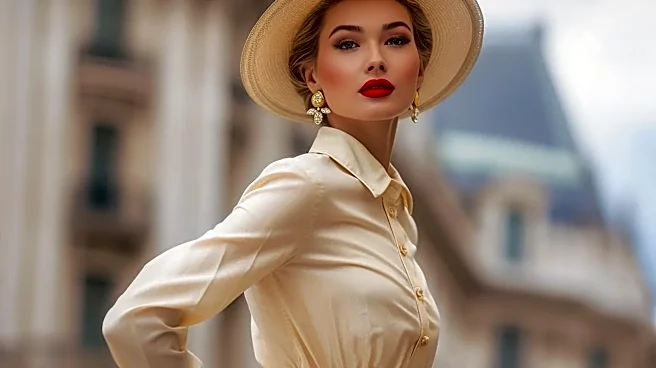
On February 12, 1947, Christian Dior debuted his first collection in a war-weary Paris. The effect was seismic. After years of fabric rationing and utilitarian, boxy silhouettes dictated by wartime necessity, Dior presented a vision of radical femininity.
His signature design, which featured soft, rounded shoulders, a tightly cinched waist, and a voluminous, mid-calf skirt, was a sensation. Carmel Snow, the influential editor-in-chief of Harper's Bazaar, famously exclaimed, "It's such a new look!"—and the name stuck. The story has been polished into a modern myth: Dior, the lone artistic genius, single-handedly revived Paris as the world's fashion capital and gave women a new, aspirational way to dress. It’s a compelling tale, but it conveniently omits the industrial powerhouse who made it all happen.
Meet the 'King of Cotton'
The hidden influence behind the New Look wasn't a muse or a rival designer, but a businessman: Marcel Boussac. Known as the 'King of Cotton,' Boussac was a textile magnate and, at the time, one of the wealthiest men in France. After World War II, Boussac was sitting on a mountain of fabric with a collapsed market. He needed a way to make France, and the world, fall in love with buying textiles again. He initially approached Dior to helm an existing fashion house, but Dior, then a relatively unknown designer, had a bolder idea: his own house, with his own vision. Boussac saw an opportunity. Dior's vision of opulence and extravagant silhouettes would require vast amounts of fabric—exactly what Boussac needed to sell. He agreed to back Dior, investing a staggering 60 million francs to establish the House of Dior in 1946.
More Than Just the Money
Boussac's contribution was far more than a blank check. His backing was a strategic move to resurrect his own industry. The New Look's profligate use of fabric—some skirts used more than 13 yards—was a direct reflection of Boussac's commercial needs. While Dior was the creative architect, dreaming up flower-like women and hourglass figures, Boussac provided the raw materials and the industrial-scale ambition. This partnership allowed the House of Dior to operate at a couture scale from its very first day, a luxury unheard of for a new brand. The New Look wasn't just a design revolution; it was a business plan. It was a calculated effort to restore not just Parisian glamour, but the nation's entire textile industry, with Boussac's mills at the center. The art of Dior and the commerce of Boussac were inextricably linked.
Why History Prefers the Lone Genius
So why is Boussac so often a footnote in this iconic story? For one, the narrative of the solitary artist overcoming the odds is simply more romantic. It fits our cultural preference for stories of singular genius over complex collaborations, especially those involving commerce. Furthermore, Dior himself rarely mentioned his powerful backer in his own memoir, cementing his own legacy as the central figure. The story of a brilliant industrialist using a couturier to move product is less magical than that of a designer inspired by the memory of his mother's Belle Époque dresses. While other figures were crucial to Dior's studio, like his “second self” Raymonde Zehnacker who organized the entire operation, Boussac’s influence was foundational. Without his financial might and his strategic need to sell fabric, the New Look as we know it—lavish, voluminous, and revolutionary—may never have left the sketchpad.