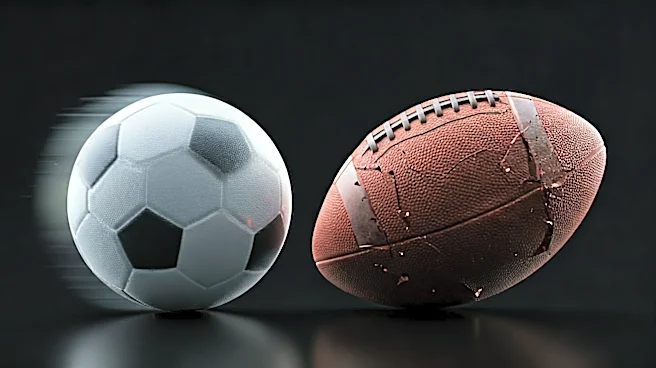







Football Offside: A Simple Line in the Sand
Let’s start with what most U.S. sports fans know. In American football, offside is beautifully simple. Before the snap, two invisible walls exist at the line of scrimmage, separated by the neutral zone (the length of the football). If a defensive player crosses that line and makes contact with an opponent before the ball is snapped, it’s a penalty. That’s it. The purpose is clear: to ensure a fair start. It prevents a defender from getting a head start and steamrolling the quarterback or blowing up a run play before it even begins. It’s a rule about discipline and maintaining order at a single, static moment in time—the snap. It’s a foul line you don’t cross early. The violation is spatial, immediate, and usually obvious to everyone in the stadium.
Soccer Offside: A Rule of Time and Space
Now, take a deep breath. Soccer’s offside is not about a static line; it's about the relationship between players in a constantly moving game. An attacking player is in an “offside position” if they are nearer to the opponents' goal line than both the ball and the second-to-last opponent (the last opponent is usually the goalkeeper). Crucially, being in that position is not an offense in itself. The penalty only occurs if that player, from that advanced position, becomes involved in active play at the exact moment a teammate passes the ball forward to them. It’s a two-part test: were you in an offside position *when the ball was kicked*, and did you then gain an advantage from it? This is why you see goals disallowed—the player was legal when they started their run, but by the time their teammate struck the ball, they had drifted past that second-to-last defender.
The Core Philosophy: Static Order vs. Dynamic Flow
Herein lies the fundamental difference. Football’s offside is a rule designed to regulate a single, explosive event: the snap. It’s about ensuring fairness at the starting block. Its existence creates the violent, contained collisions that define the sport. Once the play begins, the concept of offside vanishes completely until the next snap. Soccer’s offside is the opposite. It’s a rule designed to govern the entire 90 minutes of fluid, continuous play. Its purpose is to prevent “poaching” or “goal-hanging”—an attacker simply camping out next to the goalkeeper, waiting for a long, lazy kick. Without it, the beautiful, intricate passing and strategic buildup that define modern soccer would disappear, replaced by a game of long-ball Hail Marys. It forces attackers and defenders to engage in a constant tactical battle over space.
Impact on the Game: The Offside Trap
The difference in philosophy creates wildly different impacts. In football, an offside penalty gives the offense five free yards and a do-over. It’s an inconvenience, but rarely a game-defining moment. In soccer, the offside rule is a central tactical weapon. Defenses practice the “offside trap,” where the entire back line surges forward in unison just before a pass is made, deliberately putting the attacker in an offside position. It’s a high-risk, high-reward maneuver that requires immense coordination. Forwards, in turn, time their runs to perfection, curving and delaying their sprints to “beat the trap” and remain onside by a matter of inches. The entire vertical shape of the game, the high defensive lines, and the constant cat-and-mouse game between strikers and center-backs are all direct consequences of this one complex rule.