



The Cauldron of Pressure
The walk from the center circle to the penalty spot is arguably the longest journey in sports. With the cacophony of tens of thousands of fans crashing down and the weight of a nation’s hopes on their shoulders, a player is utterly alone. Research shows
that penalty conversion rates drop significantly in shootouts compared to regular match play—from around 85% down to 76%—a clear indicator of the immense psychological strain. The goal, a 24-foot-wide frame, suddenly seems to shrink. The opponent is not just the goalkeeper but the suffocating pressure of the moment itself. Players who rush the process are far more likely to miss; those who take a moment after the referee’s whistle have a demonstrably higher success rate. But in this cauldron, time and logic warp, and primal fear takes over.
The Anatomy of the Stare-Down
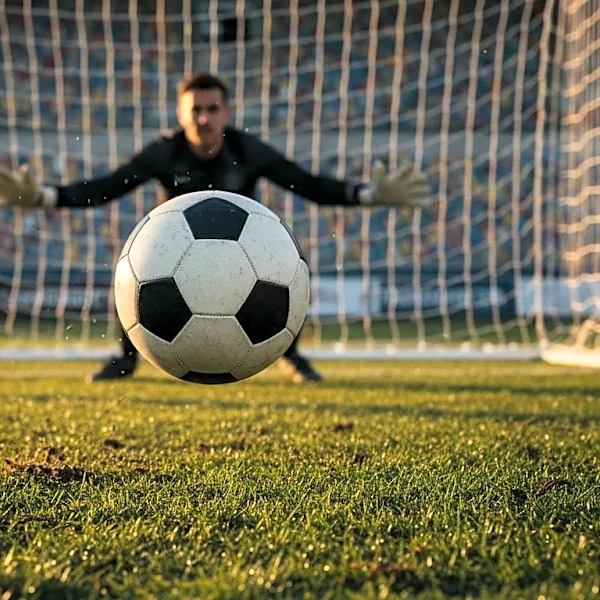
This is where the masters of psychological warfare thrive. Goalkeepers like Argentina’s Emiliano Martínez have turned the penalty shootout into their personal theater. It’s not just about stopping the ball; it’s about stopping the mind of the man taking the kick. Martínez himself calls his strategy creating “chaos.” The tactics are a masterclass in disruption: delaying the kick by questioning the ball’s placement, engaging in trash talk, or throwing the ball away to force the kicker to retrieve it. The stare is the centerpiece of this performance. A steady, unblinking gaze is designed to do one thing: make the kicker think. It's a non-verbal challenge, an assertion of dominance meant to shatter the taker's routine and plant a seed of doubt. Studies have shown that a moving or distracting goalkeeper can significantly impair a kicker's accuracy, causing shots to be hit closer to the center of the goal where they are easier to save.
The Science of Choking
When a player is subjected to this level of mental pressure, their brain can betray them. The act of kicking a penalty, a skill honed over thousands of hours until it becomes automatic, suddenly becomes a conscious process. This is what psychologists call “choking under pressure.” The pre-frontal cortex, responsible for analytical thought, hijacks the muscle memory stored in the motor cortex. Instead of relying on instinct, the player starts overthinking: “Does he know where I’m going? Should I change my spot?” This hesitation is fatal. The kicker’s focus shifts from their target to the goalkeeper, a phenomenon that research links directly to a higher likelihood of missing. The fear of losing is a powerful force; players taking a kick to avoid defeat score less than 60% of the time, whereas those kicking to win the match succeed over 90% of the time. The goalkeeper’s stare is a direct attack on the kicker’s composure, designed to trigger this exact spiral of self-doubt.
The Kicker's Last Stand
So what can a penalty taker do? The conventional wisdom is simple: pick your spot, commit to it, and shut out the noise. Easier said than done. The most successful penalty takers exhibit what researchers call a “quiet eye”—a steady, forward-facing gaze at their intended target in the moments before the kick. Looking away, especially turning your back on the keeper, is seen as a submissive stress response and is correlated with a higher miss rate. To combat the mind games, some teams have developed counter-tactics. The “bodyguard” approach involves teammates shielding the kicker from the goalkeeper’s antics before the kick is taken. Another is the “decoy,” where one player appears to be taking the kick, absorbing the psychological attacks, before handing the ball to the actual taker at the last second. These strategies are all aimed at preserving the kicker’s routine and mental calm, creating a protective bubble against the chaos the goalkeeper is trying to create.