








Fighting for a Foothold
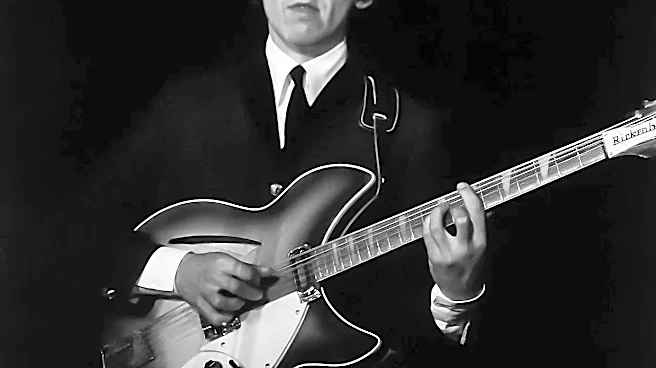
In the early days of The Beatles, the band's creative engine was the prolific partnership of John Lennon and Paul McCartney. As the youngest member, Harrison was initially viewed primarily as the lead guitarist, not a songwriter. While Lennon and McCartney had
been honing their craft together for years, Harrison was developing his own voice in relative solitude. Getting a song onto an album was a constant struggle; he was typically limited to one or two tracks per record, leaving him with a growing backlog of material that would later populate his blockbuster solo album, "All Things Must Pass." This dynamic wasn't necessarily born of malice—Lennon and McCartney simply had a head start and a seemingly endless supply of hits—but it forced Harrison to carve out a musical identity that was distinctly his own.
A Different Musical Language
The core of the band's confusion stemmed from Harrison speaking a different musical language. While Lennon and McCartney were masters of the Western pop idiom, Harrison’s musical curiosity led him eastward. After encountering a sitar on the set of the film "Help!", he developed a deep fascination with Indian classical music, eventually studying under the master Ravi Shankar. This wasn't just a passing phase; it fundamentally reshaped his approach to melody, rhythm, and structure. Songs like "Within You Without You" and "Love You To" introduced drones, sitars, and tablas to a pop audience, instruments and concepts that were entirely foreign to his bandmates. His lyrics also took a turn, exploring metaphysical and spiritual themes inspired by Hindu philosophy, a stark contrast to the love songs and narrative storytelling that dominated the charts.
The 'Naughty' Chords
Even beyond his Indian-influenced work, Harrison’s chord progressions were often unorthodox. Unlike his bandmates, who couldn't read or write music and composed intuitively, Harrison's intuition led him to complex and unexpected places. His friend Tom Petty recalled that Harrison loved using what he called "naughty chords"—diminished, augmented, and major 7th chords that defied simple pop formulas. These sophisticated harmonic choices gave his songs a unique emotional depth but could be challenging to grasp. He would invent new chord fingerings to capture a specific feeling of frustration or longing, as he did on "I Want To Tell You." His compositions often featured surprising key changes and modulations that sounded perfectly natural in the final product but were anything but straightforward to construct.
A Mix of Awe and Bewilderment
The other Beatles' reaction to Harrison's growing songwriting prowess was a mixture of respect and bewilderment. Lennon, who could be dismissive at times, also praised Harrison's work, famously calling "Something" the best song on "Abbey Road." Yet, the process could be painstaking. The 2021 documentary "Get Back" shows Harrison patiently trying to get his bandmates to grasp his new songs, sometimes meeting a wall of incomprehension. McCartney later acknowledged that by the end of the band's run, Harrison's songs were "at least as good as ours." Their confusion wasn't a judgment on quality, but a reflection of Harrison's singular journey. He wasn't just writing songs; he was channeling a worldview shaped by spirituality and a global musical palate, creating something that was often beyond their immediate frame of reference.