




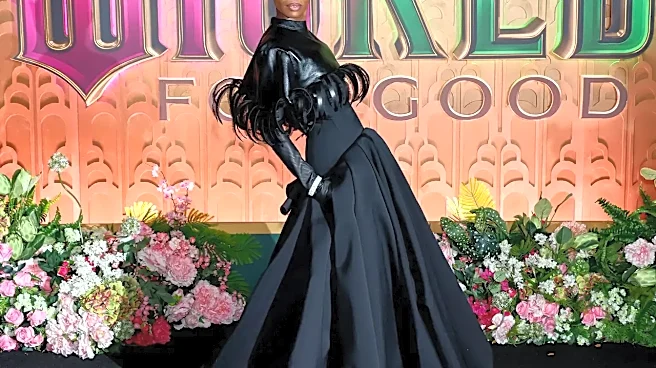


For two decades, Glinda the Good's philosophy was defined by one bubbly, brilliantly shallow anthem: 'Popular.' But the film 'Wicked: For Good' gives her a new, soul-searching solo, 'The Girl in the Bubble.' The contrast is everything.
The Gospel of 'Popular'
If you know anything
about 'Wicked,' you know 'Popular.' It is Glinda's effervescent mission statement in Act I, a tornado of pep and questionable advice wrapped in a deceptively brilliant showtune. The song is a masterclass in characterization. In her attempt to give the green-skinned, socially ostracized Elphaba a makeover, Glinda lays out her entire worldview. It isn't about intelligence, talent, or even kindness; it's about image. 'It's not about aptitude,' she chirps, 'it's the way you're viewed.' To Glinda, goodness is synonymous with being liked. Her ambition is to be adored, and she sees this as a noble pursuit she can bestow upon her morose new roommate. The song is hilarious and endlessly catchy, but its lyrics betray a profound superficiality. It is the anthem of performative goodness, where changing your hair and learning 'the proper way to flirt' are the keys to a successful life. This is the Glinda we meet: a character who navigates the world by ensuring the world loves looking at her.
The Confession of 'The Girl in the Bubble'
Then comes 'The Girl in the Bubble.' A new song written by Stephen Schwartz for the second film, 'Wicked: For Good,' it is the antithesis of 'Popular' in every way. Where 'Popular' is bright and frantic, 'Bubble' is a quiet, melancholy ballad. It finds Glinda at her breaking point, watching from her palace as a mob gathers to hunt the friend she once tried to make over. The lyrics are a stark confession: 'There's that beautiful girl, with a beautiful life,' she sings, 'Such a beautiful life, built on lies.' The 'bubble' is both her literal mode of transport and a metaphor for the privileged, insulated existence she has chosen—floating above the turmoil of Oz while benefiting from its corrupt system. This isn't a song about teaching someone else how to be palatable. It's a song of painful self-reflection, where Glinda finally confronts the moral cost of her popularity and decides, in her own words, that it's time for her bubble to pop.
Two Songs, Two Different Glindas
Placed side-by-side, the two songs illustrate one of modern musical theater's most compelling character arcs. 'Popular' is Glinda the instructor, a guru of surface-level charm who believes she can fix any problem by making it more palatable to the public. 'The Girl in the Bubble' is Glinda the penitent, a leader realizing her complicity and understanding that true goodness requires sacrifice, not just smiles. The first song is an external action, aimed at changing Elphaba. The second is a profound internal shift, as Glinda reckons with herself. In 'Popular,' her focus is on navigating social structures; in 'The Girl in the Bubble,' it's about dismantling them, starting with the one she built around herself. Onstage, this transformation is more gradual, often seen in her reactions and her verses in 'For Good.' But the film gives her a definitive solo moment that, as actress Ariana Grande noted, is where the character truly earns the title of 'Glinda the Good' for herself.
Why the Contrast Matters 'For Good'
Adding a new song to a beloved score is a risky move, but 'The Girl in the Bubble' justifies its existence by completing the thematic circle 'Popular' opened. The story of 'Wicked,' as conceived by writer Winnie Holzman and composer Stephen Schwartz, was always centered on the friendship between its two heroines. By splitting the film into two parts, the creators gave themselves the space to deepen each woman's journey. The first film solidifies Elphaba's path, while the second is largely about Glinda's trajectory to becoming the person she was meant to be. 'The Girl in the Bubble' is the dramatic engine for that change. It provides the quiet, devastating answer to the loud, confident questions posed in 'Popular.' It asks what happens after you get everything you ever wanted and realize you've lost who you are. The contrast isn't just musical; it's philosophical. It elevates Glinda from a sometimes-ditzy sidekick to a woman whose moral awakening is as powerful and world-changing as Elphaba's magical defiance.