





The Scene We All Know and Love
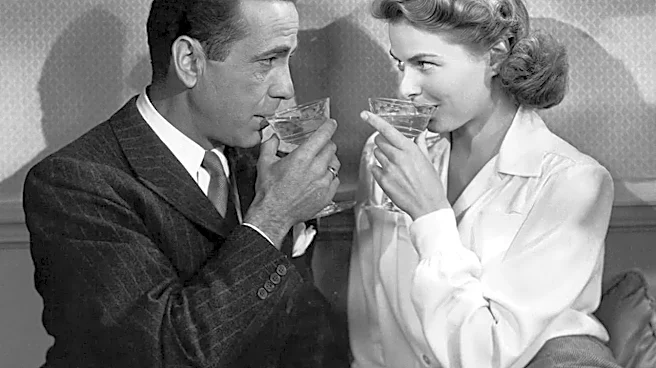
Picture it: the propellers of a plane cut through the fog at a Moroccan airport. Rick Blaine (Humphrey Bogart) tells Ilsa Lund (Ingrid Bergman) that she won't be staying with him, but leaving with her husband, resistance leader Victor Laszlo. Ilsa is luminous,
her face a heartbreaking canvas of love, duty, and unbearable loss. “We’ll always have Paris,” Rick says, sealing one of cinema's most potent and bittersweet goodbyes. For her entire, celebrated career, this scene remains arguably Ingrid Bergman’s most famous. What audiences never saw was that the conflict on her face was not just acting; it was genuine confusion.
A Script in Complete Chaos
The production of Casablanca is legendary for being an absolute mess. The script, based on an unproduced play called "Everybody Comes to Rick's," was being rewritten constantly, sometimes on the very day scenes were to be shot. A team of writers, including Julius and Philip Epstein and Howard Koch, passed pages back and forth, often with conflicting ideas. The film was shot mostly in sequence, not for artistic reasons, but because the writers literally hadn't figured out how the story was supposed to end. This created an atmosphere of profound uncertainty for the cast, who were building their performances on narrative quicksand.
A Frustrated Star, a Cryptic Director
No one was more frustrated by this chaos than Ingrid Bergman. She desperately needed to know her character's motivation. Who did Ilsa truly love? Who would she choose in the end? Her performance depended on it. According to Hollywood lore, she repeatedly approached director Michael Curtiz for an answer. But Curtiz had no answer to give, because the studio itself hadn't decided. Instead of clarifying, he gave her the cryptic, yet ultimately brilliant, instruction that would define the performance: “Play it in between.” He told her to look at Rick with love, and to look at Laszlo with love, and to keep the emotion suspended somewhere in the middle.
An Actor's Confusion Becomes Art
Forced to work without a clear destination, Bergman channeled her real-life frustration and confusion directly into her portrayal of Ilsa. Her uncertainty as an actress became Ilsa's torturous indecision as a character. Every glance, every tear-filled look of longing and loyalty, was tinged with genuine ambiguity because she simply didn't know which man she was supposed to end up with. Humphrey Bogart, in his first major romantic lead role and annoyed by the constant script changes, retreated into himself, which perfectly fed Rick's cynical, closed-off persona. The off-screen distance and on-set confusion between the actors created an accidental, yet palpable, tension that sizzled on screen.
The Last-Minute Masterpiece
The iconic ending, where Rick nobly sacrifices his love for a greater cause, was decided upon late in the production. One of the primary reasons for this choice was the Hays Code, Hollywood's strict censorship at the time, which would not have allowed a story to reward adultery by letting Ilsa leave her husband for Rick. The final lines were penned just days before the scene was shot. When Bergman finally delivered that performance on the foggy soundstage—the plane a cardboard cutout and the fog hiding the set's limitations—she was working with a conclusion that was as new to her as it would be to the audience. The result is a perfect storm of happy accidents, where a chaotic process and a confused actress combined to create one of the most emotionally authentic and enduring moments in cinematic history.