







From Covert Secrecy to Public Policy
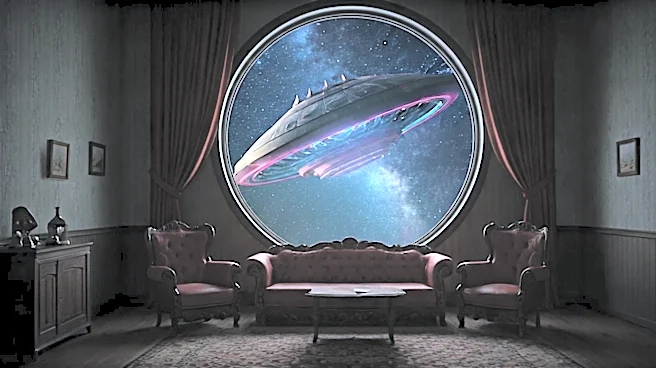
For decades, the unofficial “playbook” for unidentified anomalous phenomena (UAPs) has been simple: deny, debunk, and classify. It’s a strategy built for a national security state operating in the shadows. But a hypothetical “Disclosure Day”—a formal,
public acknowledgment of non-human intelligence or technology—instantly renders that playbook obsolete. The problem would shift from being a secret held by a handful of intelligence agencies to a public policy crisis managed in the open.
Suddenly, questions that were once the domain of conspiracy forums become urgent legislative priorities. Who owns the retrieved technology? How is it regulated? Which congressional committees get oversight? The Pentagon’s playbook of silent containment would be replaced by a chaotic, transparent, and intensely political process. Every press conference would become a global event, and every leaked document could trigger market panics or international incidents. The new playbook wouldn’t be about keeping a secret, but about managing a reality that has already escaped the bottle.
Science on a New Frontier
The current scientific playbook for extraterrestrial life is SETI (Search for Extraterrestrial Intelligence), which involves listening for distant radio signals. It’s a respectable, patient, and entirely theoretical pursuit. Claims of physical craft, however, are often met with professional ridicule. Disclosure Day would flip this on its head. The new scientific imperative would no longer be searching for faint signals from light-years away, but analyzing verifiable, physical evidence right here on Earth.
Imagine the scramble. Physicists would be forced to contend with materials or propulsion systems that defy known laws. Biologists might have to analyze non-terrestrial organic matter. The slow, methodical process of peer review would be overwhelmed by the urgency of understanding potentially transformative—or threatening—technology. Funding would flood into new departments, creating a gold rush for “meta-material” analysis and reverse-engineering. The scientific method would be put to its ultimate test, moving from a position of skepticism to one of frantic, high-stakes discovery.
A New Geopolitical Game Board
The Cold War playbook was built on a bipolar world where the U.S. and the Soviet Union were the only players that mattered. The current UAP playbook seems to operate on a similar assumption: whichever nation masters this technology first “wins.” Disclosure would shatter this framework. The confirmation of a non-human intelligence, especially one with superior technology, introduces a new, powerful piece to the global chessboard.
Initial reactions would likely follow old patterns: a panicked arms race to replicate the technology and gain a military edge. But a more profound shift would soon follow. Would humanity unite against a perceived external factor, as so many sci-fi stories suggest? Or would nations like China and Russia see it as an opportunity to upend the U.S.-led global order? The new playbook for international relations would have to account for an unprecedented variable. Alliances could be redrawn not based on economics or ideology, but on who is perceived to have a line of communication with the visitors, or access to their technology.
Rewriting Our Place in the Universe
Perhaps the most profoundly rewritten playbook would be our own sense of self. For millennia, human philosophy, religion, and culture have been built on the premise that we are the sole occupants of the thinking universe, or at least the pinnacle of creation on this planet. Disclosure Day effectively ends that story.
This isn't just an intellectual adjustment; it's a deep, psychological, and spiritual one. Religions would face an existential crisis: do they adapt their doctrines to include other intelligent beings, or do they risk becoming obsolete? Our entire anthropocentric worldview—the idea that humanity is the measure of all things—would crumble. The new playbook for being human would require a radical sense of humility. We would be forced to see ourselves not as the center of the story, but as one chapter in a much larger, more complex, and infinitely more mysterious cosmic narrative.