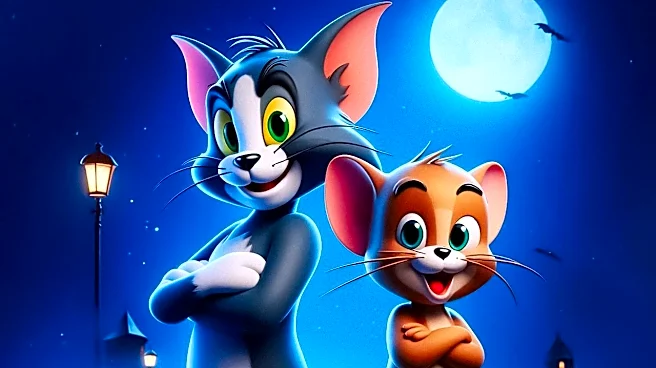









The enduring appeal of Mr. Magoo lies in his miraculous ability to walk through utter chaos completely unscathed and blissfully unaware. For those who love watching a well-meaning bumbler trip into greatness, here are seven hidden gems.
The Party (1968)
Peter Sellers perfects
the 'fish-out-of-water' archetype as Hrundi V. Bakshi, a kind-hearted but disastrously clumsy Indian actor. After accidentally blowing up a massive film set, he's mistakenly invited to a swanky Hollywood party. What follows is a masterclass in escalating comedic mayhem. Bakshi navigates the high-society gathering with a Magoo-like innocence, his every well-intentioned action—from trying to clean his muddy shoe to feeding a parrot—spiraling into pandemonium. The film's loose, improvisational feel allows Sellers to create a character who, despite the chaos he causes, remains utterly sympathetic.
The Tall Blond Man with One Black Shoe (1972)
In this classic French spy farce, an unsuspecting violinist named François Perrin (Pierre Richard) is randomly chosen to be a decoy for a master spy. Rival intelligence factions descend upon him, interpreting his every clumsy, absent-minded action as the work of a brilliant secret agent. Much like Magoo, Perrin is completely oblivious to the life-threatening situations swirling around him, from seductive assassins to hidden microphones. The comedy lies in watching the serious spies over-analyze his mundane life, convinced his mismatched shoes are a secret code.
Being There (1979)
Perhaps the most profound take on the Magoo archetype, this satirical masterpiece stars Peter Sellers as Chance, a simple-minded gardener who has never left his employer's home. When he's forced out into the world, his plain-spoken gardening advice is mistaken for profound economic and political wisdom. Chance is the ultimate oblivious protagonist; he doesn't understand the world, and the world, in turn, completely misunderstands him, elevating him to the highest corridors of power. It’s a sharp, funny, and surprisingly gentle critique of a media-saturated society ready to project meaning onto a blank slate.
Mon Oncle (1958)
French director Jacques Tati’s beloved character, Monsieur Hulot, is the spiritual European cousin to Mr. Magoo. In 'Mon Oncle,' the charmingly gauche Hulot navigates the bewildering new world of postwar modernism, epitomized by his brotherstinlaw's absurdly automated, sterile home. Hulot, with his pipe and trench coat, is a gentle agent of chaos, accidentally disrupting the rigid, hightech world of the Arpel family with his oldfashioned humanity. The film is a visual comedy, using clever sight gags to contrast Hulot's warm, bumbling nature with the cold, impersonal world he wanders through.
The Naked Gun (1988)
While hardly a 'hidden' gem, no list of bumbling heroes is complete without Police Squad's Lt. Frank Drebin. Leslie Nielsen's deadpan delivery is the key to what makes Drebin a perfect evolution of the Magoo type. He is a man of intense seriousness and complete incompetence. He walks through crime scenes causing more destruction than the criminals, utterly oblivious to the mayhem he leaves in his wake. The genius of Drebin is that, unlike Magoo, he's supposed to be the one in charge, making his oblivious trail of destruction all the more hilarious.
After Hours (1985)
For a darker , more surreal spin on the theme , Martin Scorsese 's cult classic is essential viewing . Griffin Dunne plays Paul Hackett , a mild - mannered office worker who , over one long night in SoHo , finds himself in a series of increasingly bizarre and dangerous situations . While Paul isn 't as blissfully unaware as Magoo — he ' s terrified — he shares the sense of being an ordinary man adrift in a world operating by rules he cannot comprehend . Every attempt to get home pulls him deeper into a nightmare vortex of punk - rock clubs , angry mobs , and mysterious artists , making for a uniquely stressful , and hilarious , urban odyssey .