

Football Is a Game of Set Pieces
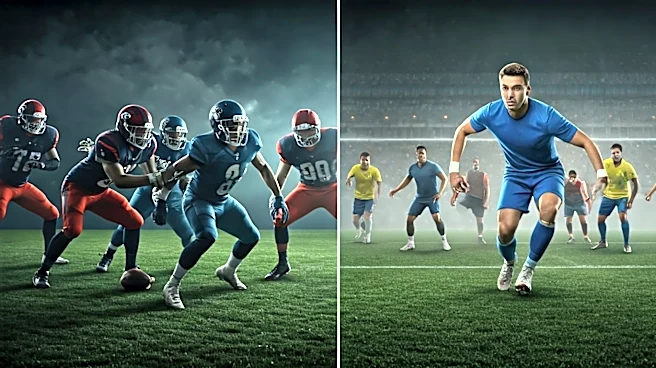
Think about how you watch an NFL game. It’s a series of discrete, high-stakes events. Each down is a self-contained strategic battle with a clear start and finish. Before the snap, coaches, quarterbacks, and even casual fans can scan the field and identify the weak link. Is your third-string cornerback lined up across from their All-Pro receiver? That’s a mismatch, and the offense is probably throwing a fade route in his direction. The game’s structure, built on downs and distance, constantly pauses the action, allowing for deliberate analysis and exploitation. It’s like a series of chess problems. The personnel groupings are announced, the formations are set, and the one-on-one battles are clearly defined before the ball is even snapped. This
stop-start nature makes football an ideal sport for isolating variables and pointing to a single, obvious point of failure.
Soccer Is a Game of Constant Flow
Soccer is the opposite. It’s a game of perpetual motion and fluid dynamics. Barring an injury or a goal, the ball is in play for 45-minute stretches. There are no downs, no resets, no timeouts for the coach to draw up a play to exploit a specific player. A mismatch in soccer isn’t about a single, isolated confrontation; it's about a weakness that reveals itself over time and space. A slow fullback isn't a problem when the ball is on the other side of the field. His lack of pace only becomes a mismatch when the opponent orchestrates a rapid switch of play, forcing him to cover a huge patch of grass against a speedy winger. You can’t just circle him on a telestrator before the play. The mismatch is created by the flow of the game itself, making it far more subtle and conditional.
Specialized Roles vs. Generalist Duties
American football is the pinnacle of specialization. Every player has a highly specific job. A nose tackle’s primary role is to occupy blockers and stop the run. A deep safety’s job is to prevent the long pass. This specialization makes it easy to grade performance. If the defensive end consistently gets stonewalled by the left tackle, that’s a lost mismatch. If a receiver can’t create separation from a cornerback, that’s another. In soccer, players are far more versatile. A modern fullback is expected to defend, support the midfield, overlap on the attack, and deliver crosses. A forward is often the first line of defense, expected to press the opposition's defenders. A mismatch, then, is rarely about one skill. It might be a technically brilliant midfielder who lacks the defensive work rate to track back, creating a vulnerability that only appears during transitions from offense to defense. It’s not a failure of his core job, but a weakness in his overall game that a smart opponent can exploit.
Individual Battles vs. Systemic Failures
The most visible football mismatches are individual. It’s about one man beating another. In soccer, the most devastating mismatches are often systemic. They prey on a team’s shape and organization. For instance, a team might employ a high-pressing system, but if one forward is lazy and doesn’t close down his man, the entire structure collapses. The opposition can easily pass through the first line of pressure, and suddenly the midfielders and defenders are facing an overload. To the casual eye, it might look like the midfielder made a mistake, but the real mismatch was the forward who failed to do his job 50 yards up the field. Spotting this requires watching the game holistically—understanding the team's tactical system and identifying the player who is breaking the chain, rather than just watching the man on the ball.