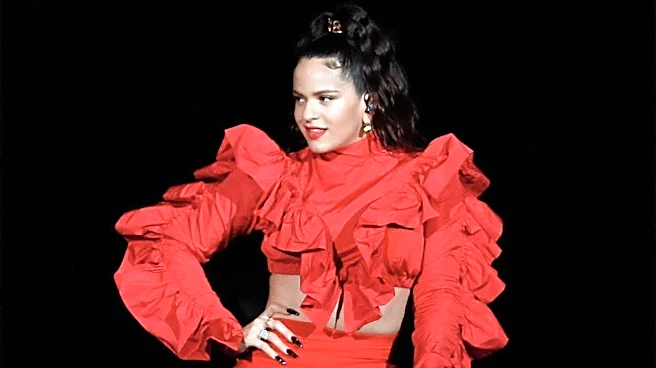








Two of Latin music’s most compelling forces, Rosalía and Mon Laferte, are on a collision course at the 2026 Latin Grammys. Both are up for the night's biggest awards, yet they arrive via starkly different artistic and philosophical roads.
Rosalía: The Global, Genre-Bending Innovator
Rosalía’s path
to the Latin Grammys has been one of relentless, high-concept evolution. The Spanish artist, who started with a purist's approach to flamenco, has become a global avatar of avant-pop. Her journey is defined by transformation; from the flamenco-trap fusion of 'El Mal Querer' to the reggaetón collage of 'Motomami,' she treats genres as ingredients for a larger sonic experiment. This year, she’s nominated for her album 'LUX (Complete Works),' a project that continues her ambitious fusion of art pop and classical elements. With seven nominations, including Album of the Year and Record of the Year for 'La Perla,' her strategy is clear: push boundaries, deconstruct mainstream sounds, and present them as high art. Her path is global, intellectual, and built on a high-fashion, social-media-savvy persona that treats music as part of a larger, boundary-pushing artistic statement.
Mon Laferte: The Visceral, Vintage-Clad Auteur
Chilean singer-songwriter Mon Laferte walks a road paved with raw emotion and reverence for the past. Her artistry is rooted in the theatrical, heart-on-her-sleeve traditions of bolero, cumbia, and torch-song balladry. Unlike Rosalía’s experimental futurism, Laferte’s power comes from her ability to inhabit vintage styles with a fiercely modern, personal, and often political perspective. She arrives at the Grammys with six nominations for 'Femme Fatale,' an album steeped in lounge jazz and bolero, with every song penned by Laferte herself. Nominations for Album of the Year, Record of the Year, and Song of the Year for the title track underscore the academy's respect for her potent songwriting and powerful, melodramatic vocals. Her path is one of the auteur—a deeply personal, instrument-driven, and emotionally direct artist who channels the ghosts of Latin American popular music to tell her own unfiltered stories.
A Tale of Two Philosophies
The contrast between the two is a fascinating snapshot of modern Latin music's incredible breadth. Rosalía is a musical architect, building complex new structures from disparate, global parts. Her work invites analysis and decoding, from its sonic textures to its academic and artistic references. Mon Laferte is a vessel of pure feeling. Her music doesn't ask to be analyzed so much as it demands to be felt, channeling the timeless sorrows and joys of love, heartbreak, and social struggle with a visceral intensity. Where Rosalía uses technology and sampling to create a sense of futuristic dislocation, Laferte often records live with an ensemble to capture a specific, organic warmth. One is a conceptualist who transforms, the other is a traditionalist who refines.
The Grammy Gamble: Innovation vs. Tradition
On November 12, the Latin Recording Academy's voters will deliver their verdict from Las Vegas. Their choice in the major categories where both artists compete—Album, Record, and Song of the Year—will be telling. A win for Rosalía’s 'LUX' would signal a preference for bold, category-defying innovation and global ambition. It would reward the artist who is actively redefining what Latin music can sound like on the world stage. A victory for Mon Laferte’s 'Femme Fatale' would be a powerful endorsement of classic songwriting, raw vocal performance, and the enduring power of Latin America’s own rich musical traditions. It would celebrate an artist who proves that looking inward and backward can be just as revolutionary as looking forward. Both are formidable contenders, representing two valid and vital definitions of artistic excellence.