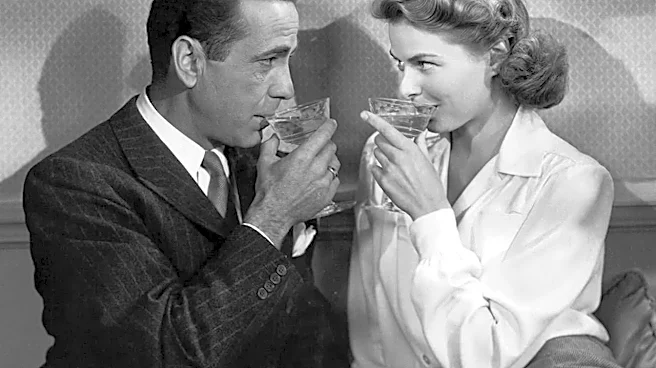







Humphrey Bogart is an icon defined by a handful of timeless roles. But beyond the trench coats and fedoras of his most famous films lies a gallery of complex, daring, and overlooked performances that reveal the true depth of his talent.
The Petrified Forest (1936)
Before he was the
cynical hero, he was the terrifying villain. As escaped killer Duke Mantee, Bogart is a coiled spring of feral energy. This is the role that made him a star, yet many modern fans have never seen it. Reprising his Broadway part, Bogart modeled the character on John Dillinger, creating a portrait of a desperate man with haunted eyes who holds a roadside diner hostage. It was co-star Leslie Howard who refused to make the film without Bogart, a move that launched his career at Warner Bros. Watching him here is like seeing the raw material for the iconic persona that would follow: the simmering violence, the world-weary gaze, all present in its most undiluted form.
High Sierra (1941)
This film marks the crucial bridge between Bogart the gangster and Bogart the leading man. As 'Mad Dog' Roy Earle, an aging bank robber on his last job, he delivers a performance filled with surprising nuance. Written by John Huston, the script gives Bogart more to play with than just a tough-guy exterior; Earle is a man out of time, loyal by a code no one else follows, and capable of unexpected tenderness. Paired with Ida Lupino, Bogart creates a character who is both a hardened criminal and a tragic anti-hero, a man 'rushing toward death'. The same year he'd become Sam Spade in 'The Maltese Falcon,' but 'High Sierra' is arguably where the iconic Bogart we know was truly born.
Dead Reckoning (1947)
Slipping comfortably into the film noir genre he helped define, Bogart stars as Rip Murdock, a paratrooper captain investigating the mysterious death of his war buddy. The trail leads him into a labyrinth of deceit and into the arms of a classic femme fatale played by Lizabeth Scott. While it shares DNA with his more famous detective films, 'Dead Reckoning' stands on its own as a gritty, convoluted thriller. Bogart is in his element, narrating in flashback and navigating a post-war world of suspicion and betrayal. It's a quintessential, hard-boiled Bogart role that often gets lost in the shadow of 'The Big Sleep' but delivers all the cynical charm and tough-guy poetry fans could want.
In a Lonely Place (1950)
Many critics consider this Bogart's finest, most vulnerable performance, yet it remains far less known to the general public than 'Casablanca'. He plays Dixon Steele, a Hollywood screenwriter with a violent temper who becomes the prime suspect in a murder. The film is less a whodunit and more a devastating character study of a troubled man whose inner demons threaten to destroy his one chance at love with a neighbor, played by Gloria Grahame. Bogart, whose own company produced the film, channels his own complexities into the role, creating a portrait of rage and selfloathing that is terrifying and heartbreaking. It's a dark, uncompromising film that deconstructs the very tough guy persona he perfected.
Beat the Devil (1953)
Proof that Bogart could be hilarious, 'Beat the Devil' is a bizarre, satirical adventure he made with director John Huston. A notorious flop that Bogart himself lost money on, it has since become a beloved cult classic. He plays one of a group of eccentric crooks stranded in an Italian port town, all scheming to get their hands on uraniumrich land in Africa. The script was famously written on the fly by a young Truman Capote, giving the film a chaotic, almost improvised energy. Surrounded by a cast of oddballs, Bogart plays the exasperated straight man, a knowing wink at the international intrigue roles that made him famous. It’s a strange, oneofakind film that shows a side of the actor rarely seen.