




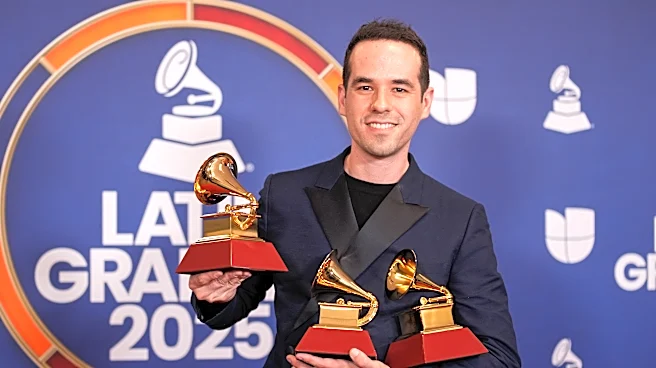
The Latin Recording Academy has announced a special 2026 honor for Chichí Peralta, a move that celebrates his revolutionary sound. But what exactly made the Dominican maestro's percussion-driven crossover style a turning point in Latin music?
An Overdue Honor for a Dominican Icon
The Latin
Grammys have long celebrated the titans of song, but this year's special merit accolades shine a light on one of the great architects of modern Latin fusion. Chichí Peralta, the visionary Dominican bandleader and percussionist, will be honored for his groundbreaking career, which redefined the possibilities of tropical music. For many, his name is synonymous with the irresistible late-90s hits that seemed to pour out of every radio from Santo Domingo to New York City. But behind those infectious melodies was a quiet revolutionary at work. Peralta was not just a musician; he was a producer and arranger who treated the recording studio as a laboratory, meticulously layering sounds and rhythms into something entirely new. This honor recognizes him not just for his hits, but for the very fabric of the sound he created—a sound that continues to echo in the work of artists today.
Deconstructing a 'World Tour in a Song'
So what is 'percussion-driven crossover'? In the 1990s, merengue was a global force, but often followed a familiar, horn-heavy formula. Peralta flipped the script. He took the foundational Dominican rhythms of merengue and son and treated them not as a finished product, but as a starting point. From there, he layered elements from across the globe. You can hear the improvisational freedom of jazz in his piano lines, the tight, syncopated pulse of American funk in his bass, and the complex, polyrhythmic conversations of West African drumming. His band, Son Familia, was a sight to behold—a small army of percussionists playing everything from traditional tamboras and güiras to congas, bongos, and timbales. The result was music that felt like a passport. A single song could transport you from a Santo Domingo street party to a New Orleans jazz club and back again, all held together by an undeniable, earth-shaking groove. It was a world tour in a four-minute track.
The Global Impact of 'Pa' Otro La'o'
This audacious new sound was fully unleashed on his 1997 masterpiece, 'Pa' Otro La'o' ('To the Other Side'). The album was a commercial juggernaut and a critical revelation. It spawned 'Procura' and 'Amor Narcótico,' two songs that became unofficial anthems of a generation. 'Procura,' with its instantly recognizable piano intro and desperate, romantic plea, is built on a bed of impossibly intricate percussion that never overwhelms the melody. 'Amor Narcótico' slows things down, blending a son montuno feel with a smoky, jazzy atmosphere that felt both timeless and futuristic. These weren't just Latin hits; they were global phenomena that transcended language barriers precisely because their primary language was rhythm. The album proved that tropical music could be both deeply rooted in tradition and wildly experimental, appealing to purists and casual listeners alike.
A Legacy Forged in Rhythm
Peralta's influence is less about direct imitation and more about the permission he gave other artists to explore. He demonstrated that commercial success and artistic innovation were not mutually exclusive. Before the age of streaming made global collaborations commonplace, he was creating a dialogue between musical cultures within his own band. Artists who blend cumbia with hip-hop or bachata with electronic music are walking down a path Peralta helped pave. He proved that the DNA of Latin music was resilient enough to absorb outside influences without losing its identity. This Latin Grammy honor serves as a formal acknowledgment of what many have known for decades: Chichí Peralta wasn't just making people dance; he was composing the future, one beat at a time.