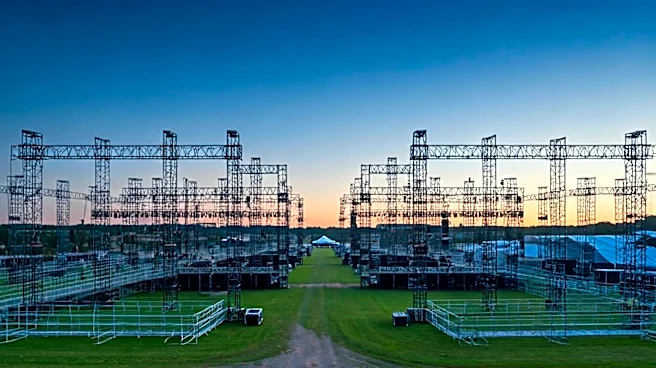








The Blueprint on a Blank Canvas
Long before the first roadie arrives, the transformation begins with a team of production managers and engineers staring at… nothing. An empty field isn’t a blank slate; it’s a puzzle. They conduct a meticulous site survey, analyzing the topography to determine
the best orientation for the stage to minimize sound bleed and maximize sightlines. Is the ground stable enough to support hundreds of tons of steel, or will it need reinforcement? Where are the access points for dozens of 18-wheelers? This initial phase is like digital architecture. Using specialized CAD software, they create a master plan that maps out everything: the stage footprint, the location of the audio and lighting control tower (known as Front of House), the placement of delay towers for sound, and the sprawling network of temporary roads, security fencing, medical tents, and vendor villages. Every square foot is accounted for before a single piece of equipment is unloaded.
Raising the Steel Skeleton
Once the plan is set, the build begins. This isn’t a simple platform; it’s a temporary skyscraper. The main stage is constructed from modular steel or aluminum truss systems, assembled like a giant, high-stakes Erector Set. Cranes lift massive sections into place while crews of specialized riggers bolt them together. The primary concern is physics. The structure must be able to support the immense weight of video walls, lighting rigs, and speaker arrays—often exceeding 100,000 pounds—while also withstanding unpredictable weather. Engineers calculate wind load and ensure the stage is properly ballasted or anchored to the ground. This phase is a race against the clock, often running 24 hours a day under massive light towers. What looks like a chaotic construction site is actually a highly choreographed operation where safety and precision are paramount.
The Science of Outdoor Sound
Getting clear, powerful audio to 50,000 people in an open field is one of the biggest challenges in live production. Unlike an arena, there are no walls to reflect sound. The solution is the iconic, curved speaker setup you see hanging on either side of the stage: the line array. These systems are designed to throw focused sound over long distances. But that’s only half the battle. To ensure the fans in the back hear the same thing as the fans in the front, and at the same time, audio engineers use a series of delay towers—smaller speaker clusters placed strategically throughout the audience area. These towers receive a slightly delayed audio signal, perfectly timed to sync with the sound traveling from the main stage. This creates a seamless, immersive audio experience, preventing the garbled echo that would otherwise ruin the show for anyone more than a few hundred feet back.
Powering a Temporary City
A modern festival stage has the power appetite of a small town. You can’t just plug it into a wall socket. The entire event runs on a farm of tow-behind generators, some the size of shipping containers. These power not only the sound and lights but also the video screens, broadcast trucks, catering, and office trailers. Running the power is a monumental task in itself, involving miles of thick, heavy-duty cabling laid in protective rubber tracks across the field. The key to a smooth show is redundancy. Every critical system has a backup generator and an uninterruptible power supply (UPS). If one generator fails, another one automatically kicks in, ensuring the show goes on without a single light flickering. This invisible web of power is the central nervous system of the entire operation.
Beyond the Main Attraction
The stage may be the centerpiece, but turning a field into a theater involves building an entire ecosystem around it. The Front of House position is a multi-level tech fortress where engineers control every light, sound, and video cue. Miles of security fencing create a secure perimeter. Fleets of golf carts and ATVs become the official transportation network on a sprawling site. Behind the scenes, a command center staffed by security, medical personnel, and production heads acts as the event’s mission control, monitoring weather patterns and crowd flow. From sanitation crews managing thousands of portable toilets to vendors setting up miniature restaurants, the effort extends far beyond the spectacle itself. It is, for a few short days, a fully functioning, purpose-built city dedicated to music.