







The Lure of the Spec Sheet
Walk into any electronics store or browse online, and you'll be hit with a wall of technical specifications. For keyboards, the conversation usually revolves around mechanical switch types (clicky, tactile, linear), key travel distance, polling rates
for gaming, and whether it has flashy RGB lighting. These are quantifiable metrics that are easy to compare. A 1000 Hz polling rate is objectively faster than 125 Hz. A Cherry MX Blue switch has a defined actuation force. We're conditioned to believe that better numbers mean a better product. But for the growing category of split keyboards, this numbers-first approach misses the entire point. The true value isn't in the speed of the hardware, but in how the hardware fundamentally changes your relationship with the act of typing itself.
It Starts With Your Wrists and Shoulders
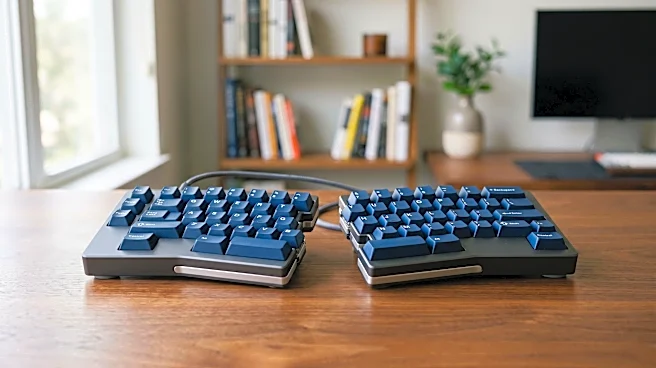
The most obvious benefit of a split keyboard is ergonomics, a term that gets thrown around so much it’s almost lost its meaning. Here, it’s about correcting a fundamental flaw in traditional keyboard design. A standard keyboard forces your hands close together, making your wrists bend outward to align with the keys—a posture ergonomists call 'ulnar deviation'. This unnatural angle constricts the carpal tunnel, reduces blood flow, and strains muscles from your fingertips to your shoulders. A split keyboard solves this by letting you place each half at shoulder width. This simple change allows your wrists to stay straight, your arms to rest naturally, and your shoulders to relax instead of hunching forward. Many split models also offer 'tenting', which lifts the inner edges of the keyboard to reduce forearm pronation, moving your hands closer to a more neutral 'handshake' position.
Unlocking Your 'Typing Brain'
This is the real secret. Physical discomfort is a constant, low-level distraction for your brain. Even if you don't consciously notice the strain from an awkward typing posture, your brain does. It spends a small but continuous amount of cognitive energy managing that physical stress. When you eliminate that strain with a split keyboard, you're not just preventing injury; you're freeing up mental resources. That mental energy can be redirected toward focus, creativity, and problem-solving. Neuroscience research suggests that when the body is properly supported, neural signals for motor tasks travel more efficiently, leading to smoother typing and fewer errors. The result is a state of 'flow' that's difficult to achieve when your brain is subconsciously fighting against your own desk setup. The performance boost isn't about faster key presses; it's about a clearer, more focused mind.
A Tool That Is Truly Yours
Beyond the initial ergonomic fix, true mastery of a split keyboard comes from its deep customizability—something no spec sheet can quantify. Most split keyboards allow for complete key remapping and the use of layers. Don't like where the 'Enter' key is? Move it. Use a specific symbol constantly for coding? Program it to a dedicated thumb key. This turns the keyboard from a one-size-fits-all device into a bespoke instrument tailored to your specific workflow. Programmers might create a layer for debugging commands, while writers might create one for navigation shortcuts to avoid reaching for the mouse. This level of personalization creates a seamless connection between thought and execution, reducing wasted motion and mental friction. You’re no longer adapting to the tool; the tool is adapting to you.
The Investment of the Learning Curve
It’s important to be realistic: switching to a split keyboard, especially one with a columnar or ortholinear layout, involves a learning curve. Forcing your hands to re-learn proper touch-typing can feel slow and frustrating at first. Users often report it takes anywhere from a few weeks to a couple of months to get back to and eventually surpass their original typing speed. However, this adjustment period is not a drawback but an investment. It’s an opportunity to unlearn bad habits and build a healthier, more efficient way of interacting with your primary work tool. The short-term dip in productivity is a small price to pay for the long-term gains in comfort, focus, and physical well-being.