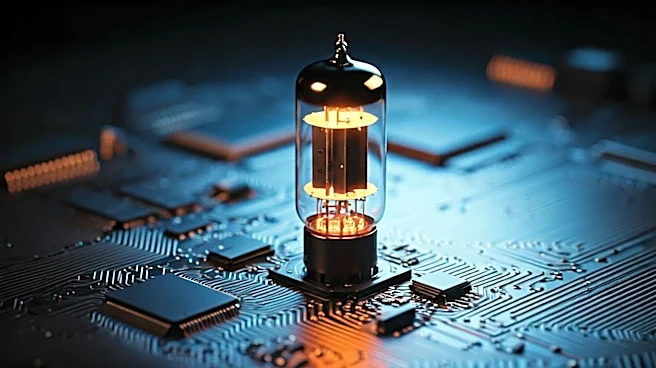











Before von Neumann: The Rewiring Nightmare
To understand why the von Neumann architecture was so revolutionary, you have to appreciate how terrible its predecessors were. Imagine the first large-scale electronic computer, the ENIAC, completed in 1945. It was a 30-ton behemoth built to calculate
artillery firing tables for the U.S. Army. It could perform complex calculations thousands of times faster than a human, but it had a crippling flaw: its 'program' was hardwired.Programming the ENIAC didn't involve typing code. It involved physically rerouting cables and flipping thousands of switches, a process that could take a team of operators days or even weeks. Changing the computer's task from calculating a missile trajectory to, say, modeling a weather pattern was a monumental physical effort. The computer was powerful, but it wasn't flexible. It was more like a highly specialized, one-trick calculator than the all-purpose machines we know today. This was the central problem facing the pioneers of computing: how do you build a machine that can be easily and quickly told what to do next?
The Breakthrough: The Stored-Program Concept
The conceptual leap that changed everything is known as the 'stored-program concept.' The idea was deceptively simple: what if the computer's instructions weren't part of its physical wiring, but were stored in its memory, just like the data it was working on? If you could store instructions as numbers, the computer could manipulate its own programming. It could read a list of commands from memory, execute them one by one, and then be given a completely different list of commands without anyone touching a single wire.This is the heart of the design detailed in John von Neumann’s famous 1945 paper, "First Draft of a Report on the EDVAC." The proposed machine would have a central processing unit (CPU), a control unit to interpret instructions, and a single, unified memory bank that held both the program instructions and the data. This simple, elegant model is the foundation of virtually every computer built since.
The 'Real Reason': It Was Simpler and Possible
So, what's the 'real reason' it was designed this way? It wasn’t just theoretical elegance. It was engineering pragmatism, born from the severe limitations of 1940s technology. The building blocks of these early computers were unreliable, expensive, and power-hungry vacuum tubes. Building two separate, specialized memory systems—one for instructions and one for data (a design now known as the Harvard architecture)—would have been more complex, more expensive, and required more of these failure-prone components.A single, unified memory was simply easier and more feasible to build. This decision, however, came with a built-in trade-off that still defines computing today: the 'von Neumann bottleneck.' Because instructions and data have to travel along the same physical path to get to the processor, the system can only do one thing at a time: fetch an instruction or fetch data. It can't do both simultaneously. This bottleneck has been a central challenge for computer architects for over 75 years, a direct consequence of a practical compromise made when a room-sized computer had less processing power than a modern musical greeting card.
A Genius, a Feud, and a Lasting Legacy
History often smooths out the messy details. While the architecture bears his name, John von Neumann didn’t invent it in a vacuum. The core ideas were developed collaboratively by the team building the ENIAC and its successor, the EDVAC, most notably J. Presper Eckert and John Mauchly. Von Neumann, a brilliant consultant on the project, synthesized these ideas in his "First Draft" and published it under his own name. Because the paper was widely distributed, his name became irrevocably attached to the concept, sparking a bitter and long-running attribution dispute.Regardless of who deserves the primary credit, the design's influence is undeniable. It established a standard that allowed software to become separate from hardware, creating the very concept of a software industry. The von Neumann architecture wasn't the only possible way to build a computer, nor was it necessarily the 'best' in a theoretical sense. It was, however, the right design at the right time—a practical, achievable blueprint that made the modern digital world possible.