




More Than Just a Straight Line
If you look at a map of the world’s nearly 1.5 million kilometers of submarine fiber-optic cables, you might assume they follow the most direct path between two points. After all, shorter cable means less cost, right? While that’s partially true, the reality
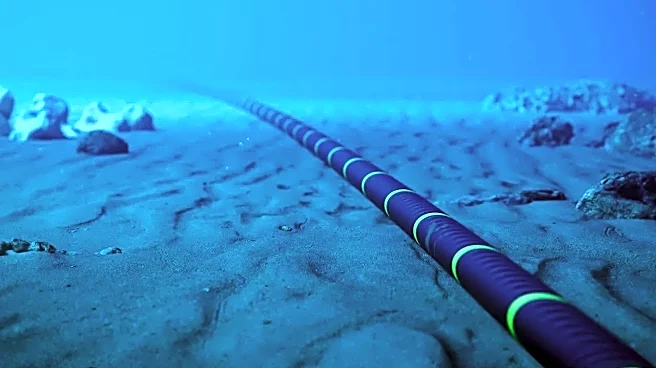
is far more complex. The primary goal of any cable-laying operation is survival. Engineers spend fortunes on meticulous marine surveys to chart the ocean floor. The goal is to find a path that avoids underwater mountains, deep-sea trenches, active volcanoes, and landslide-prone zones—anything that could damage a cable no thicker than a garden hose. These cables are laid with plenty of slack, like an extension cord across a lawn, to accommodate the terrain and even the slow drift of tectonic plates. So while a great-circle route is the starting point, the final path is a cautious, winding journey dictated by geology first and foremost.
Following Imperial and Telegraphic Footprints
To understand today’s internet map, you have to look back to the 1850s and the dawn of the telegraph. The first successful international cables, like the one connecting Britain and France in 1851, were instruments of commerce and colonial administration. By the late 19th century, Great Britain had laid a global network—the 'All Red Line'—connecting its vast empire, from Canada to Australia. British companies owned and operated nearly two-thirds of the world's cables. Many of today’s most important fiber-optic routes follow these same 150-year-old telegraph paths. Why? Because the landing points were already established in friendly, politically stable territories. The legal rights-of-way were secure, and the initial work of identifying safe marine corridors had already been done, creating a powerful path of least resistance for modern infrastructure to follow.
Where the Money Flows, Data Follows
While history and geology laid the groundwork, modern cable routes are overwhelmingly driven by cold, hard cash. Today, over 98% of all submarine cables are financed and owned by private companies—first telecom consortiums, and now increasingly, tech giants like Google, Meta, Amazon, and Microsoft. These companies aren't laying cables for the public good; they're building them to connect their massive, power-hungry data centers and serve the world's most lucrative markets. As a result, the global cable map is heavily skewed toward connecting major financial and technological hubs in North America, Europe, and East Asia. A new trans-Pacific cable can cost upwards of $400 million, an investment that only makes sense if it links regions with enough customers and data traffic to generate a return. This economic reality is the single biggest factor determining where new capacity is built.
The Geopolitical Power Play
Cables don’t just carry Netflix streams and video calls; they transmit over 95% of all international data, including trillions of dollars in daily financial transactions and sensitive military communications. This makes them instruments of national security and geopolitical leverage. Nations are acutely aware that whoever owns or has access to these cables has a distinct intelligence advantage. This has led to a new era of competition, particularly between the U.S. and China. Governments now actively intervene in cable projects, blocking routes or equipment from 'adversary' nations and funding friendly projects to ensure secure data pathways between allies. A cable that passes through a rival’s territorial waters is seen as a security risk, vulnerable to tapping or sabotage. As a result, new routes are increasingly designed to bypass potential geopolitical chokepoints, making the seabed a new front in global power struggles.