


An Accidental Genius for AI
Founded in 1993, Nvidia’s mission was to solve the complex problem of 3D graphics for video games. The result was the Graphics Processing Unit, or GPU. Unlike a computer’s main brain (the CPU), which handles tasks one by one, a GPU is a master of parallel
processing—handling thousands of simple tasks simultaneously. Think of a CPU as a master chef meticulously preparing one complex dish, while a GPU is an army of line cooks chopping thousands of vegetables at once. This architecture was perfect for rendering millions of pixels on a screen. Unbeknownst to many, it was also perfect for the massive, repetitive calculations required by artificial intelligence.
The Masterstroke: Building a Software Moat
Hardware alone wasn't enough. In 2006, Nvidia made its most important move, releasing a software platform called CUDA (Compute Unified Device Architecture). Before CUDA, using a GPU for non-graphics tasks was an arcane, frustrating process. CUDA changed everything by giving developers and scientists a direct way to program the thousands of cores inside Nvidia’s GPUs using standard programming languages. This created a powerful ecosystem. As researchers began experimenting with AI, they naturally used the most accessible tools, which were Nvidia’s GPUs, thanks to CUDA. This software layer effectively locked in the scientific and AI communities for over a decade, creating a competitive advantage that rivals are still struggling to overcome.
The 'Big Bang' Moment for Deep Learning
The pivotal moment arrived in 2012. A neural network named AlexNet, trained on just two Nvidia gaming GPUs, shattered records in an influential image recognition competition. It demonstrated that GPU-powered deep learning wasn't just a theory; it was a practical reality that vastly outperformed traditional methods. The AI world took notice, and the race was on. Researchers and major tech companies quickly realized that Nvidia’s hardware, combined with its CUDA software, was the key to unlocking the potential of deep learning. Demand for GPUs exploded, not from gamers, but from the data centers that would become the foundation of the modern AI industry.
Powering the Everyday AI You Use Now
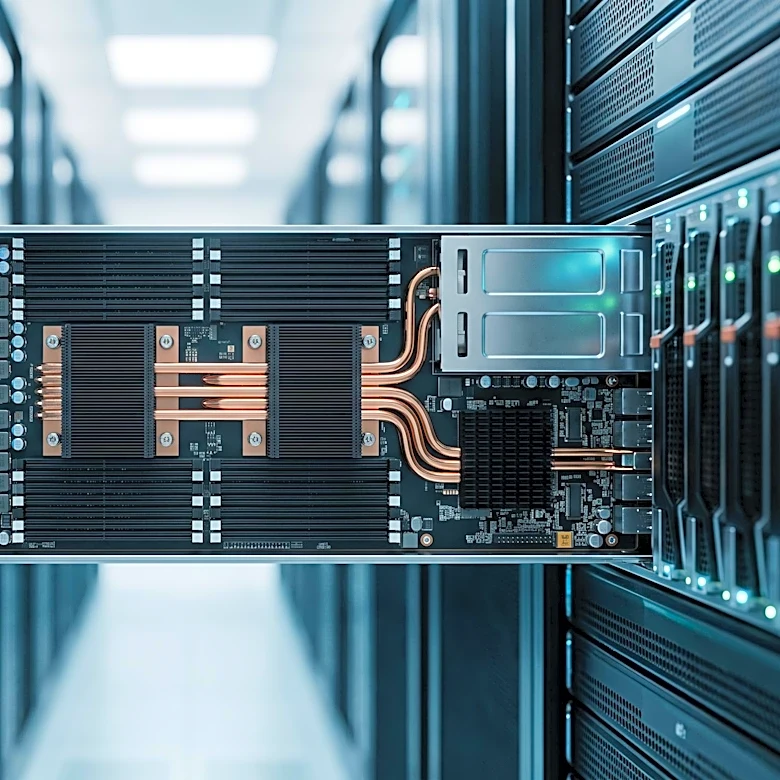
Today, that same core technology powers the AI applications that have become part of daily life. When you ask a chatbot a question, generate an image, or use an AI-powered feature in an app, the request is sent to a massive data center filled with tens of thousands of Nvidia GPUs. While companies like OpenAI and Google build the AI models, Nvidia provides the essential hardware—the 'picks and shovels' in the AI gold rush. By some estimates, the company controls over 75% of the AI chip market. From its specialized Hopper and Blackwell architecture chips to integrated supercomputing systems, Nvidia has moved far beyond just selling components. It now provides the full-stack infrastructure that makes the entire AI economy run.