






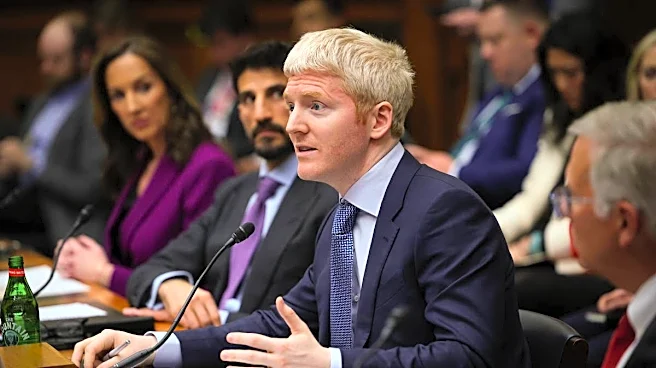
Patrick Collison
If Max Levchin wrote the first chapter on modern online payments with PayPal, Patrick Collison (along with his brother John) wrote the next. As the CEO and co-founder of Stripe, Collison embodies the Levchin principle of obsessive focus on a technically
difficult problem that everyone else finds boring. In the late 2000s, setting up online payments was a nightmare for developers. Stripe’s insight was to treat it as a developer-first API problem. By creating a clean, elegant, and powerful system, Stripe enabled a new generation of internet businesses to get off the ground without wrestling with legacy banking infrastructure. Like Levchin, who famously developed early anti-fraud systems for PayPal, Collison’s success is built on a foundation of brilliant engineering applied to the unglamorous but essential plumbing of the internet economy.
Brian Armstrong
Max Levchin and the "PayPal Mafia" waded into the chaotic, untrusted world of online money transfers in the late 90s. More than a decade later, Brian Armstrong did the same for an even more volatile asset: cryptocurrency. By founding Coinbase, Armstrong took on the monumental task of building a trusted, regulated, and user-friendly gateway to the world of digital currencies. This mirrors Levchin's journey with both PayPal and Affirm, which involved navigating immense regulatory hurdles and convincing mainstream consumers to trust a new way of managing their finances. Armstrong’s achievement was not just building the technology, but wrapping it in a layer of security and legitimacy that made crypto accessible to millions, turning a niche interest into a major financial industry.
Jensen Huang
Max Levchin is known for playing the long game, building foundational companies like Affirm over many years. Jensen Huang, the founder and CEO of NVIDIA, is perhaps the ultimate icon of long-term, technically-driven vision. Huang bet the entire company on the graphics processing unit (GPU), believing it would be essential for more than just video games. For years, this was a difficult and highly specialized field. But his unwavering, decades-long focus on building the best possible parallel processing chips positioned NVIDIA perfectly for the artificial intelligence revolution. Huang's leadership philosophy, centered on solving problems from first principles and empowering small, expert teams, echoes the engineering-first culture Levchin fostered at his companies. Both demonstrate how relentless focus on a core technology can eventually unlock entire industries.
Palmer Luckey
Part of Levchin's legacy is his relentless entrepreneurial drive; after PayPal's massive exit, he didn't retire but went on to found multiple other companies, including Slide and Affirm. Palmer Luckey offers a modern, and even more extreme, example of this serial ambition. After founding Oculus VR as a teenager and selling it to Facebook for around $2 billion, he could have stopped there. Instead, after a controversial departure from the social media giant, he founded Anduril Industries in 2017. With Anduril, Luckey dove into one of the world's most difficult and slowest-moving industries: defense contracting. He is applying a fast-paced, Silicon Valley product mindset to build autonomous drones and surveillance systems, aiming to disrupt a sector dominated by legacy giants. This pivot from consumer tech to national security shows a Levchin-like appetite for tackling hard, valuable problems, no matter the industry.
Tony Fadell
While Levchin’s work has been primarily in software and finance, his core approach involves finding unloved product categories and reimagining them with superior engineering. Tony Fadell, known as the "father of the iPod" and the founder of Nest, is the hardware equivalent. Before the iPod, digital music players were clunky and difficult to use. Fadell’s team at Apple obsessed over the user experience, creating a device that was both powerful and intuitive. He did it again with Nest, taking a mundane household object—the thermostat—and turning it into a smart, desirable piece of technology that kickstarted the smart home market. Fadell’s genius, like Levchin's, lies in identifying a frustrating user experience caused by lazy incumbents and having the engineering and design conviction to build something radically better from the ground up.