









An Election Night Stunner
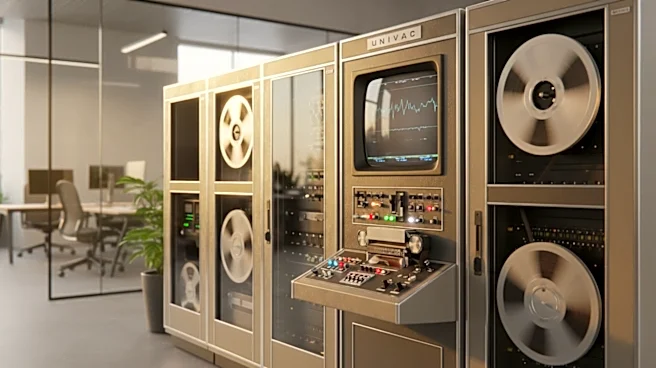
On November 4, 1952, CBS News, alongside anchor Walter Cronkite, unveiled its secret weapon for election night: the UNIVAC I. While pollsters predicted a close race between Dwight D. Eisenhower and Adlai Stevenson, the massive computer, fed only a tiny
fraction of early vote returns, predicted an Eisenhower landslide. The forecast was so unbelievable that the network initially hesitated to report it, fearing the machine was broken. But as the night wore on, the votes poured in, proving the computer stunningly accurate. UNIVAC became an overnight sensation, a household name synonymous with futuristic intelligence. For the public, this was the moment computing arrived.
More Than a Prediction Machine
But UNIVAC was never intended to be a political pundit. Its creation was the answer to a far less glamorous but much more critical problem: data. The machine's story began years earlier when its inventors, J. Presper Eckert and John Mauchly—the same minds behind the earlier ENIAC—contracted with the U.S. Census Bureau. The bureau was drowning in data from a post-war population boom and needed a way to process it all. The UNIVAC I, the first commercial computer produced in the United States, was designed specifically for this kind of large-scale data processing. Its first official delivery, on March 31, 1951, wasn't to a TV studio but to the Census Bureau, where it was put to work tabulating the 1950 census.
The Birth of the Business Computer
This is where the real revolution began. While the election stunt gave UNIVAC fame, its work for the government proved its commercial viability. Soon, private companies came calling. General Electric became one of the first non-government clients, using a UNIVAC to automate payroll calculations at its appliance facility. This was a game-changer. For the first time, a machine was being used not just for complex scientific or military calculations, but for the day-to-day operations of a business. It was designed to replace the era's punch-card accounting machines, processing thousands of digits per second to handle payroll, inventory management, and financial analysis. UNIVAC proved that there was a market for machines that could solve business problems.
The Blueprint for a New Economy
UNIVAC's early lead in the commercial market ultimately gave way to competitors like IBM, which leveraged its existing business relationships and new technologies. However, UNIVAC's true legacy was already secured. It had fundamentally shifted the perception of what a computer was for. No longer just a tool for scientists and generals, the computer was now an essential instrument for business and administration. By demonstrating a clear return on investment for tasks like data processing and automation, UNIVAC created the blueprint for the entire enterprise computing industry. Every payroll system, every inventory database, and every digital spreadsheet traces its lineage back to the moment businesses realized the power of the machine that famously called an election but was built for so much more.