






The Engineer Who Built the Future
Long before he became a fabled investor, Andreas “Andy” Bechtolsheim was a builder. Born in Germany, he arrived at Stanford University in the late 1970s and quickly became obsessed with a problem: engineers lacked affordable, powerful computers. While
a PhD student, he designed a networked workstation he called the SUN, for Stanford University Network. It was a revolutionary leap, offering the power of a minicomputer for a fraction of the cost. When established companies showed little interest, Bechtolsheim, along with Scott McNealy, Vinod Khosla, and Bill Joy, decided to build it themselves. In 1982, he dropped out of his PhD program to co-found Sun Microsystems. As the company’s chief hardware architect, he helped create the machines that would become the backbone of the early internet. This experience gave him a unique perspective: he didn’t just understand technology; he understood what it took to turn a brilliant idea into a world-changing product.
A 10-Minute Pitch on a Porch
By 1998, Bechtolsheim was already a Silicon Valley legend. He had left Sun, founded a networking company called Granite Systems, and sold it to Cisco for $220 million. That’s when a fellow Stanford professor, David Cheriton, introduced him to two graduate students. On a professor’s porch in Palo Alto, Larry Page and Sergey Brin gave him a quick demo of their research project: a search engine they called Backrub, soon to be renamed Google. In just a few minutes, Bechtolsheim saw what others had missed. While other search engines ranked pages by the number of times a search term appeared, Google’s PageRank algorithm analyzed the links between pages, essentially using the web’s own structure to determine relevance. Bechtolsheim recognized the brilliance of the approach. Reportedly, after the short pitch, he said, “I don’t want to waste time. I'm sure I'm going to like it. I'll just write you a check.”
The Check That Forced a Company into Existence
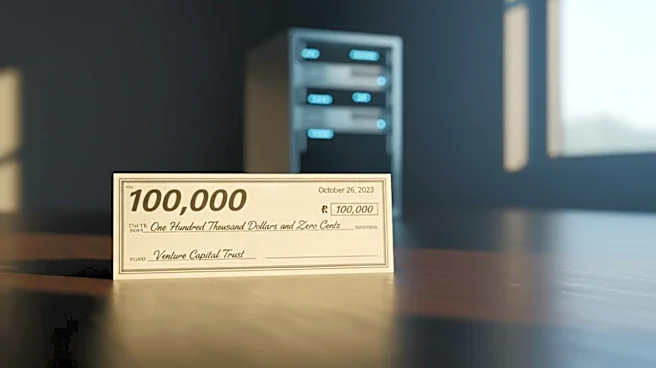
Here is the “hidden” part of the bet. Bechtolsheim grabbed his checkbook and wrote a check for $100,000. The problem? He made it out to “Google, Inc.”, a legal entity that did not exist. For weeks, the check sat uncashed in a desk drawer while Page and Brin scrambled to file the necessary paperwork to officially incorporate their company. This detail is more than just a fun piece of trivia; it’s the key to understanding Bechtolsheim’s genius. His investment wasn’t just capital; it was a forcing function. He didn’t just believe in the idea; he catalyzed it into reality. The check provided the seed money and, more importantly, the validation the founders needed to raise a full million-dollar seed round from friends, family, and other angel investors like Jeff Bezos. It was a bet on two unproven founders and a project that had yet to become a business.
From Seed to Silicon Valley Legend
That single $100,000 check cemented Andy Bechtolsheim’s legacy. His initial investment would eventually be worth billions, making it one of the greatest angel investments in history. But its value isn't just measured in dollars. The Google bet became the archetype for a new kind of Silicon Valley investing: seeing the future, backing brilliant people, and moving decisively. Bechtolsheim would go on to co-found Arista Networks, another multi-billion dollar networking company, further proving his ability to spot and build the next big thing. His story is a testament to the power of technical insight paired with conviction. He remains, first and foremost, an engineer who builds, but his most famous creation wasn't a piece of hardware. It was the spark that lit the fuse for Google, a company that would go on to organize the world's information and, in the process, change the world itself.