








Sara Blakely: The Brand-Builder Who Owned a Category
Much like Whitman turned eBay into a household name, Sara Blakely took a simple, personal solution—cutting the feet off her pantyhose—and built a category-defining empire with Spanx. Starting with just $5,000 in savings, Blakely maintained 100% ownership
for over two decades, a testament to her relentless focus on profitable growth from day one. Her genius wasn't just the product but the brand itself, which she infused with humor, relatability, and a mission of empowerment. Whitman understood that eBay's success depended on creating trust and a clear identity in the chaotic early internet. Blakely applied the same principle to apparel, proving that a powerful brand narrative is just as crucial as the product it represents.
Brian Chesky: The Marketplace Scaler
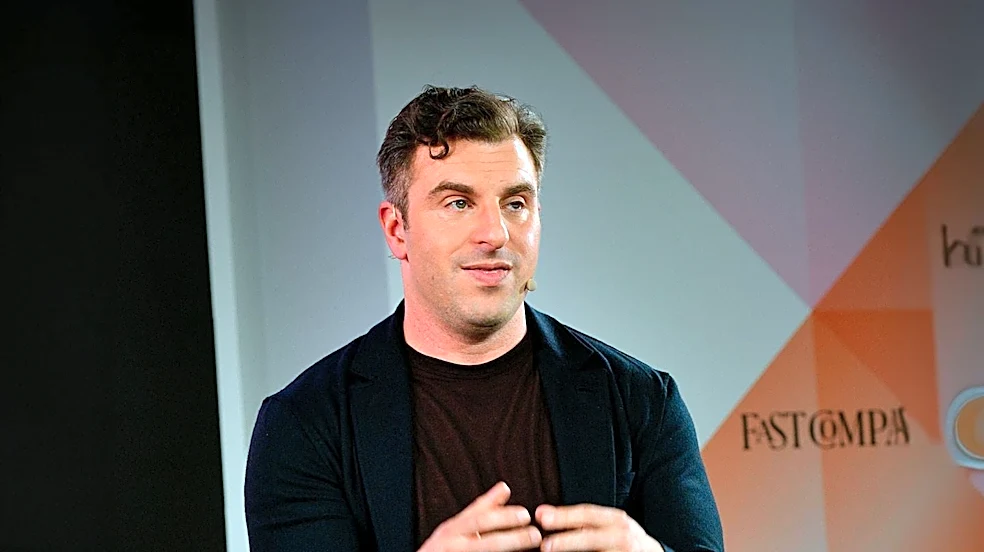
Whitman's defining achievement at eBay was managing its explosive '70% compound monthly growth rate' by scaling a complex, two-sided marketplace. Brian Chesky faced a similar challenge with Airbnb. He didn't just build a website; he built a system of trust between strangers. In the early days, Chesky and his co-founders did things that didn't scale, like personally meeting hosts and professionally photographing their apartments, to perfect the user experience. This hands-on approach allowed him to understand the core of the marketplace's value. For leaders inspired by Whitman's operational excellence at eBay, Chesky's journey shows how to handcraft a magical experience first, then build the systems to deliver it to millions.
Tony Hsieh: The Customer-Obsessed Operator
If Whitman built the 'what' of a scaled platform, the late Zappos CEO Tony Hsieh perfected the 'how.' Hsieh famously declared that Zappos was a 'service company that happens to sell shoes.' He believed that if you got the company culture right, exceptional customer service and brand loyalty would naturally follow. This manifested in legendary policies, like marathon-long customer service calls and paying new hires to quit if they weren't truly committed. While Whitman focused on metrics and strategy to manage eBay's growth, Hsieh focused on creating a fanatical devotion to customer and employee happiness as the engine of his business. He demonstrated that operational excellence can also be rooted in a deeply human-centric culture.
Reed Hastings: The Long-Term Pivot Master
Whitman’s tenure at HP involved navigating a legacy tech giant through immense industry change. Reed Hastings provides the ultimate case study in proactive transformation. He led Netflix through multiple identity-shifting pivots: from DVD-by-mail to streaming, and then from a content licenser to a world-class production studio. In 2007, he made the gutsy call to pursue streaming even though it threatened to cannibalize Netflix's profitable DVD business. This demonstrated a willingness to sacrifice a successful present for a dominant future. For leaders facing disruption, Hastings’ career shows the importance of seeing the curve before you get to it and having the courage to steer directly into the next evolution of your business, no matter how comfortable the current one feels.
Howard Schultz: The Founder-as-Savior
Howard Schultz didn't technically found Starbucks, but he is the architect of its modern identity. Like Whitman, who was brought into eBay as an outside leader to professionalize and scale a promising startup, Schultz’s legacy is defined by his ability to both build and revitalize. After stepping away, he returned as CEO in 2008 to rescue a company that had lost its way. He did this by re-centering the brand on its core values, famously closing all U.S. stores for a day to retrain baristas. His leadership demonstrates that you don't have to be the Day One founder to have a founder's impact. He embodies the leader who can step into a complex situation, reconnect the organization with its soul, and drive a historic turnaround—a skill Whitman also deployed throughout her career.