




A Radical Vision for Augmenting Intellect
Long before Silicon Valley was a household name, Douglas Engelbart had a vision that was wildly out of step with the computing world of the 1950s and 60s. At the time, computers were room-sized behemoths used for crunching numbers. Engelbart imagined
something entirely different: a tool to augment human intellect. He believed computers could be partners in creativity, communication, and collaboration. In 1963, he established the Augmentation Research Center (ARC) at the Stanford Research Institute (SRI) to pursue this radical idea. Engelbart assembled a team of brilliant, like-minded engineers and programmers who weren't just building hardware; they were building a new way for humans to interact with information.
The Demo That Showed the Future
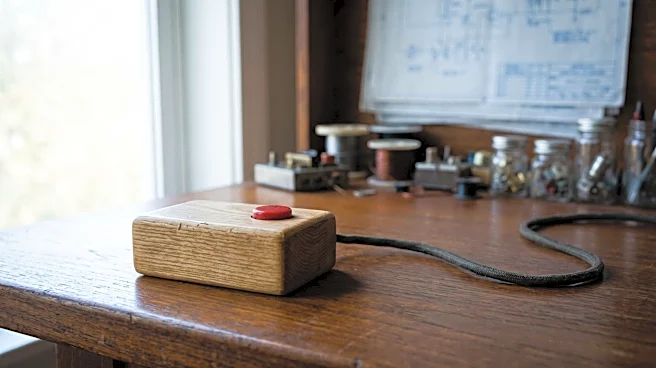
On December 9, 1968, Engelbart and his team took the stage in San Francisco for a 90-minute presentation that would become legendary. Dubbed "The Mother of All Demos," it was the world's first public demonstration of a staggering array of technologies we now take for granted. There was the mouse, a simple wooden block with wheels that controlled a cursor on the screen. But there was so much more: hypertext, on-screen windows, shared-screen collaboration via a network, and video conferencing. This wasn't just a slideshow; it was a live, interactive performance. Engelbart, on stage, collaborated in real-time with his team back at the lab 30 miles away. The man who built that first mouse from Engelbart's sketches was chief engineer Bill English, who was also instrumental in orchestrating the complex technical production of the demo itself. The lead software architect who brought the complex system to life was Jeff Rulifson, whose programming was essential to realizing Engelbart's vision.
The Great Migration of Talent
Despite the groundbreaking nature of the demo, the world didn't immediately change. The vision was so far ahead of its time that many in the industry saw it as fascinating but impractical. SRI, a research institute, wasn't structured to commercialize such a sweeping system, and eventually, funding for Engelbart's lab was reduced. The revolutionary ideas, however, didn't die; they just moved. In the early 1970s, many of ARC's key figures, including Bill English and Jeff Rulifson, left SRI. Their destination was a new, lavishly funded research center just down the road: Xerox Palo Alto Research Center, or PARC. A cruel joke at the time was that Engelbart's ARC had become a training program for Xerox PARC.
From a Quiet Lab to Every Desktop
At Xerox PARC, the seeds planted at SRI found fertile ground. The ARC alumni, now at PARC, refined and built upon their earlier work. Bill English, for instance, developed the ball mouse, an improvement on his original wheeled design. The team at PARC integrated these ideas into the Xerox Alto, a pioneering machine that is now considered the first true personal computer, complete with a graphical user interface (GUI) and Ethernet networking. The final, crucial step in this quiet revolution came in 1979, when a young Steve Jobs visited PARC. What he saw—the windows, the icons, and the mouse-driven interface—was a revelation. While Apple engineers were already exploring similar concepts, seeing the polished PARC system in action crystallized the future for Jobs. Apple licensed the mouse patent from SRI for a reported $40,000 and incorporated the GUI concepts into its Lisa and, more famously, the Macintosh, which brought the mouse and the graphical interface to the masses and forever changed American computing.