






It's Not a Cloud, It's a Cable
The single biggest misconception about the internet is that it’s primarily wireless. While your phone connects to Wi-Fi, that’s just the final few feet of a very long, physical journey. The “World Wide Web” is quite literally a web of wires. Over 95%
of all international data is transmitted not through satellites, but through a colossal network of fiber-optic cables laid on the ocean floor. There are more than 600 of these submarine cables, collectively spanning nearly a million miles, that form the true backbone of our connected world. These aren't just minor wires; they are the superhighways that carry everything from your emails and video calls to global financial transactions.
The Real Information Superhighway
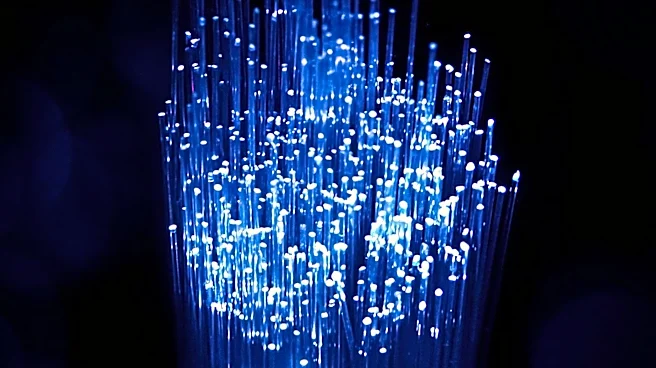
Forget the abstract notion of cyberspace. The internet's hidden reality is a series of garden-hose-thick cables stretching across the vast, dark floor of the Atlantic and Pacific oceans. Inside these heavily armored casings are bundles of hair-thin glass fibers. Data travels along these fibers as pulses of light, moving at nearly the speed of light. This physical network is what allows a video shot in Tokyo to be streamed almost instantly on a screen in Ohio. Companies have been laying these cables for decades, constantly adding more to keep up with our insatiable demand for data, driven by everything from cloud computing to high-definition streaming.
The Grand Central Stations of Data
So, what happens when these massive cables reach land? They don’t just plug into your local coffee shop. They terminate in unassuming buildings known as Internet Exchange Points (IXPs). Think of an IXP as a massive, hyper-efficient switchboard or a Grand Central Station for data. Inside these secure locations, hundreds of different internet service providers (ISPs), content giants like Netflix and Google, and other major networks physically connect their equipment. By plugging into the same exchange, they can pass traffic directly between each other, which is far faster and cheaper than sending data on a roundabout journey through third-party networks. These IXPs are the critical intersections that make the internet a true network of networks.
The Unsung Rules of the Road
Having physical highways and intersections is great, but you also need traffic rules. In the internet world, that's the job of the Border Gateway Protocol, or BGP. You can think of BGP as the internet's own postal service or GPS. When you send data, it’s broken into tiny packets. BGP's job is to look at all the possible network paths your data could take to its destination and choose the most efficient one. It’s a protocol that operates between the huge networks (known as autonomous systems) that make up the internet, constantly sharing routing information to maintain a map of the best available paths. You’ve never heard of it, but without BGP, the internet would be a chaotic mess of lost data packets.
Why This Hidden Plumbing Matters
This physical infrastructure is incredibly robust, but it's not invincible. A ship dragging its anchor can sever a multi-million dollar submarine cable, an event that happens more often than you'd think. In 2024, damage to several cables in the Red Sea and off the coast of Africa caused significant internet disruptions, affecting banking and communication for millions. When a country relies on only a few cables, a single cut can be devastating. Likewise, a simple configuration error in BGP can make a major network disappear from the internet, taking countless websites and services down with it. Understanding that the internet is a physical system helps explain why it can sometimes break and highlights the incredible engineering required to keep our digital world running smoothly.