






The World Belongs to Jensen Huang
To understand the challenge facing Apple, you first have to understand the kingdom Jensen Huang built. For over a decade, Nvidia’s CEO has been relentlessly focused on a singular vision: that Graphics Processing Units (GPUs) would be the engines of the future.
While gamers bought them for better frame rates, Huang and his team were building something far more significant: a software ecosystem called CUDA. CUDA is the moat around Nvidia’s castle. It’s a platform that allows developers to access the massive parallel processing power of its GPUs for non-gaming tasks. When the AI and machine learning boom hit, it wasn’t just that Nvidia had the best chips; it had the only viable, mature software ecosystem for building with them. Researchers, startups, and tech giants alike all built their models on CUDA. This created an incredibly sticky network effect. Today, leaving Nvidia’s ecosystem is like trying to build a modern web app without using a standard programming language. It’s not just difficult; it's a strategic disadvantage.
Apple’s Walled Garden of AI
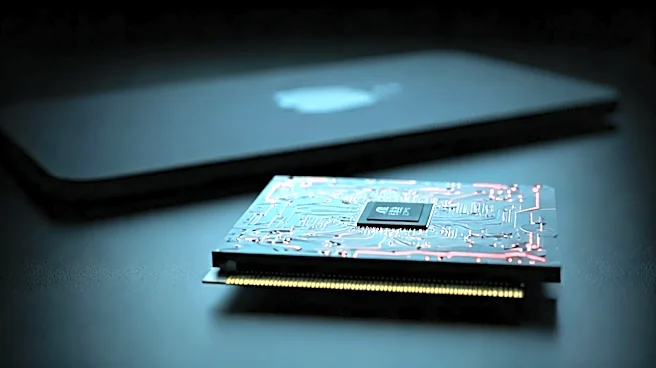
Apple’s philosophy has always been the polar opposite. It’s the master of vertical integration—designing its own silicon (A-series, M-series chips), software (iOS, macOS), and services to create a seamless, private, and highly optimized user experience. Its approach to AI, branded “Apple Intelligence,” follows this playbook perfectly. The priority is on-device processing. Your personal data, calendar, and photos are analyzed locally on your iPhone or Mac, ensuring privacy and speed. However, Apple acknowledged a crucial limitation: the most powerful AI models are too massive to run on a phone. For those tasks, Apple is building its “Private Cloud Compute” and, in a pragmatic but very un-Apple move, partnering with OpenAI to integrate ChatGPT. It’s a hybrid solution born of necessity. Apple controls the simple stuff on your device but must rely on others for the heavy lifting. This is a crack in the walled garden, and it’s a direct consequence of Nvidia’s hardware reality.
An Unstoppable Force Meets an Immovable Object
Herein lies the conflict. Apple’s long-term strategy is almost certainly to bring that heavy lifting in-house. It wants to own the entire AI stack, from the silicon in its data centers to the software on your screen. But building a competitor to Nvidia’s top-tier GPUs—and, more importantly, a software ecosystem to rival CUDA—is a monumental task that could take the better part of a decade. The AI world moves in months, not decades. Nvidia’s chips aren’t just powerful; they are a universal standard for training the large language models (LLMs) that power services like ChatGPT. Apple can’t simply buy its way to the front of the line. It must compete for the same limited supply of cutting-edge GPUs as Microsoft, Google, and Meta, all while trying to develop its own alternative. This puts Apple in the uncomfortable position of funding its chief rival for market cap supremacy while racing to make its technology obsolete.
The WWDC 2026 Question
This brings us to WWDC 2026. Two years is a lifetime in the tech industry, and it serves as a perfect marker for Apple’s strategic progress. By then, will Apple have a story to tell about its own advanced AI accelerators for data centers? Will it have wooed developers to a new Apple-native AI framework, breaking their dependency on CUDA? Or will it be announcing a deeper, more permanent partnership with a company like OpenAI, effectively conceding that it cannot—or will not—compete in the high-end AI training space? The most likely scenario is a continuation of its hybrid approach, but the balance will be telling. If Apple is still primarily talking about on-device AI and leaning heavily on partners for cloud tasks in 2026, it suggests the GPU reality crafted by Jensen Huang remains an insurmountable obstacle. But if Tim Cook takes the stage to unveil a powerful, proprietary AI hardware and software stack, it will signal a direct challenge to Nvidia’s dominance and a reassertion of Apple’s core philosophy of total control.