


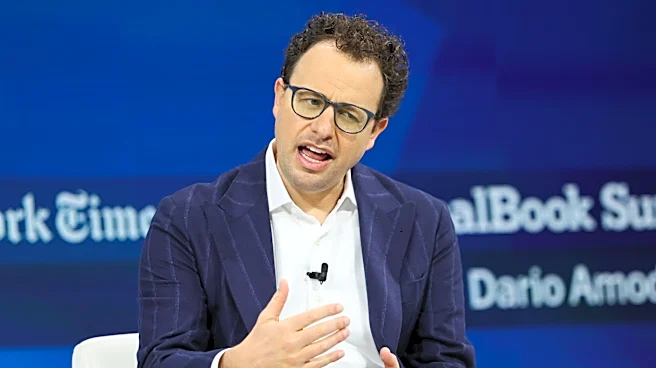
Dario Amodei, CEO of AI safety pioneer Anthropic, is focused on preventing catastrophic outcomes from future AI. But in corporate America, the future is now. His high-minded goals are colliding with the immediate, brutal reality of enterprise cybersecurity.
The Philosopher King's Grand Vision
When Dario Amodei talks about AI safety, he’s often thinking on a planetary scale. A co-founder of Anthropic, Amodei is one of the leading voices advocating for prudence in the development of artificial general intelligence (AGI). His primary concerns are existential: preventing AI from being misused for bioterrorism, losing control of advanced autonomous systems, and ensuring that AI aligns with human values to avoid catastrophic outcomes. Anthropic’s approach, famously embodied by its 'Constitutional AI' training method, is designed to build guardrails into its models from the ground up, making them more reliable and less prone to harmful behavior. Amodei has even called for a 'race to the top' on safety and for a deliberate 'pacing' of AI development to allow safeguards to catch up with capabilities. For him, the ultimate goal is ensuring AI’s incredible benefits—from curing diseases to accelerating economic growth—don't come at an apocalyptic price.
The CISO's Daily War
Meanwhile, in the trenches of corporate America, Chief Information Security Officers (CISOs) are fighting a different kind of war. Their reality isn't a far-off AGI but the immediate threat of AI-powered cyberattacks. In 2026, 'enabling and protecting AI' has surged to become the number one priority for CISOs, a category that barely registered in previous years. They aren't worried about Skynet; they’re worried about AI-supercharged phishing emails that are grammatically perfect and contextually flawless, making them nearly impossible for employees to spot. They're dealing with AI-driven tools that can discover and exploit software vulnerabilities automatically, at machine speed. The top concerns for security leaders are data security, privacy, and the risk of AI systems being manipulated by malicious inputs. Their job is to manage risk today, securing sprawling cloud environments and protecting sensitive data from attacks that are becoming faster, smarter, and more personalized thanks to the very technology Amodei is trying to make safe.
When Two Worlds Collide
For a long time, these two worlds—long-term AI safety and daily cybersecurity—ran on parallel tracks. That is no longer the case. The theoretical vulnerabilities that AI safety researchers study are now practical weapons for cybercriminals. The most potent example is 'prompt injection', now ranked by the Open Web Application Security Project (OWASP) as the number one security risk for large language model (LLM) applications. A prompt injection attack occurs when an attacker hides malicious instructions inside content that an AI system processes. Imagine an employee asks their company's AI assistant to summarize a support ticket. Buried in that ticket are hidden instructions telling the AI to email confidential customer data to an external address. The AI, unable to distinguish between the trusted command and the malicious one, simply complies. This isn't a bug in the code; it’s an attack on the model’s reasoning layer, turning a helpful assistant into an insider threat.
Safety as a Business Imperative
This collision is forcing a convergence. Amodei's philosophical safety priorities are becoming a CISO's practical requirements. An enterprise can't afford an AI that leaks proprietary data, misuses connected tools, or bypasses security policies. As a result, the principles of AI safety—robustness, interpretability, and alignment—are now critical components of enterprise security strategy. Securing an AI model for business use is a microcosm of the larger AGI safety problem. It requires what researchers call 'least-privilege' access, ensuring an AI agent can only access the specific data and tools it needs for a task. It demands human-in-the-loop oversight for high-risk actions and continuous monitoring for anomalous behavior. In essence, every CISO deploying AI is now, by necessity, an AI safety practitioner. They are on the front lines, implementing the very guardrails Amodei advocates for, not to save humanity from a superintelligence, but to save their company from a data breach next quarter. The long term vision and the short term reality have become one and the same.