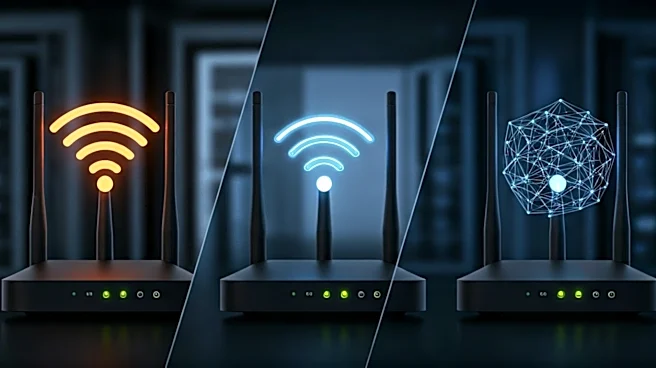










The Pragmatist’s Choice: Wi-Fi 6
First, you have the camp of engineers who champion Wi-Fi 6. Their argument isn't that it's the fastest, but that it's the smartest buy for the vast majority of Americans. Released in 2019, Wi-Fi 6 (or 802.11ax, if you’re fancy) was a massive leap forward
from its predecessor. It wasn’t just about raw speed; its killer feature was efficiency in crowded environments. Using a technology called OFDMA, it acts like a delivery truck that can carry packages for multiple destinations at once, rather than making separate trips for each. For a modern home full of phones, laptops, smart TVs, and thermostats all clamoring for bandwidth, this was revolutionary. The engineer arguing for Wi-Fi 6 is a pragmatist. They’ll point out that routers and devices are now incredibly affordable and ubiquitous. They'll also correctly note that for most U.S. households, the bottleneck isn't the router—it's the internet plan you’re paying for. If you have a 300 Mbps internet connection, a multi-gigabit Wi-Fi 7 router is like owning a Ferrari you can only drive in a school zone. For them, spending a premium on 6E or 7 is burning money for performance you can’t even use. It’s the ultimate “good enough” solution that provides real, tangible benefits without the early adopter tax.
The Realist’s Upgrade: Wi-Fi 6E
Next up is the Wi-Fi 6E advocate. This engineer agrees with the pragmatist on many points but identifies a different core problem: congestion. Wi-Fi 6 still operates on the same 2.4 GHz and 5 GHz radio bands we’ve used for decades. In a dense apartment building, these bands are like a Los Angeles freeway at rush hour—packed with traffic from your neighbors’ networks, microwaves, and old Bluetooth devices, all causing interference and slowdowns. Wi-Fi 6E’s magic trick is adding a third, brand-new band: 6 GHz. Think of it as opening a private, multi-lane superhighway exclusively for 6E-compatible devices. It’s pristine, uncongested, and wide open. The realist engineer argues this isn't a theoretical speed boost; it’s a solution to a real-world problem that plagues urban and suburban users. They might see pure Wi-Fi 6 as a half-measure and Wi-Fi 7 as an unproven, expensive gamble. For them, Wi-Fi 6E hits the sweet spot today. It offers a clear, immediate benefit (the 6 GHz band) that solves the biggest Wi-Fi headache for many, making it the most significant practical upgrade in over a decade.
The Futurist’s Investment: Wi-Fi 7
Finally, you have the futurist engineer, the one with eyes on the horizon, advocating for Wi-Fi 7. This person sees buying Wi-Fi 6 or 6E today as buying yesterday's technology. Wi-Fi 7 (or 802.11be) doesn't just use the 6 GHz band; it supercharges it with next-generation capabilities. Its signature feature is Multi-Link Operation (MLO), which allows a device to connect to a router using multiple bands (like 5 GHz and 6 GHz) simultaneously. This isn’t just for piling on speed; it creates a more resilient, ultra-low-latency connection by sending data across the clearest path available at any given moment. The futurist will tell you this is essential for the next wave of tech: flawless 8K streaming, competitive cloud gaming, and immersive AR/VR experiences that simply can’t tolerate lag. They’ll argue that a router is a 5-to-7-year investment. Why buy a device that’s merely adequate for today when you can buy one that will be ready for the devices and applications of 2028? To them, the higher cost is an investment in avoiding a frustrating upgrade in just a couple of years. They believe in buying for the network you’ll want tomorrow, not just the one you need today.
So, Who Is Right?
The disagreement persists because each engineer is optimizing for a different variable. There is no single 'best' standard; there's only the 'right' standard for a specific situation. The Wi-Fi 6 pragmatist is solving for cost and immediate value. The Wi-Fi 6E realist is solving for congestion and interference in busy environments. The Wi-Fi 7 futurist is solving for longevity and next-generation performance. The debate isn't really about technology; it's about philosophy. Are you fixing a problem you have right now, or are you building a foundation for a future you can't yet see? Answering that question is the key to understanding which side of the argument you fall on.