







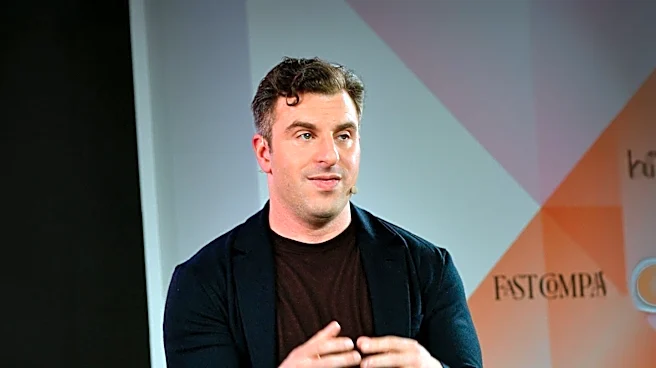

In the trinity of Airbnb founders, Nathan Blecharczyk was the technical engine. As the original CTO, he wrote the code that launched a revolution and later, as Chief Strategy Officer, he guided its global expansion. Who else embodies this potent mix?
Tobias Lütke, Shopify: The Builder-Turned-CEO
Like Blecharczyk, Tobias Lütke’s company was born from his own technical frustration. An avid snowboarder, Lütke wanted to open an online store for snowboarding gear in the early 2000s but found the existing e-commerce software clumsy and inadequate. So, he built his own. That custom software, written in just a couple of months, was so effective it quickly became more valuable than the snowboards he was selling. This act of a founder personally coding the initial product mirrors Blecharczyk’s role in programming the first version of Airbnb's website. Both men began as the master builders of their respective platforms, creating the core engine with their own hands. Lütke transitioned from a hands-on coder to the CEO of Shopify, a platform now powering millions of businesses, demonstrating a similar trajectory to Blecharczyk, who evolved from CTO to a chief strategist shaping the company's long-term future.
Patrick Collison, Stripe: The Systems Thinker
If Blecharczyk built the architecture for trust and transactions in hospitality, Patrick Collison, along with his brother John, built it for the internet itself. Stripe’s mission was to solve a problem many developers found maddening: the difficulty of accepting payments online. Much like Blecharczyk, Collison is a prodigious, self-taught programmer who saw a complex system and was driven to simplify it. He possesses a deep-seated focus on engineering excellence and long-term infrastructure, creating a product that works so seamlessly in the background that most users never see it. This parallels Blecharczyk’s work on Airbnb’s unseen but critical systems, such as payments, data science, and security screening. Both founders exemplify the 'technical founder' archetype, leveraging their engineering prowess not just to launch a product, but to build foundational infrastructure that enables entire economies to flourish on top of it.
Melanie Perkins, Canva: The Relentless Visionary
While Blecharczyk’s strength is code, his strategic success lies in making a complex service (renting a home from a stranger) feel simple and accessible. Melanie Perkins applied the same principle to graphic design. As a university student, she watched her peers struggle with complex design software like Adobe Photoshop and envisioned a simple, collaborative, web-based alternative. This mission to democratize a specialized field is the common thread. Perkins faced over 100 rejections from investors, a testament to a persistence that echoes the early, lean years of Airbnb, when the founders famously sold novelty cereal boxes to stay afloat. Perkins’s journey from teaching design in her mother's living room to leading a multi-billion dollar company showcases the strategic patience and unwavering user focus that's also a hallmark of Blecharczyk’s leadership style.
Daniel Ek, Spotify: The Industry Navigator
Airbnb’s growth required navigating a minefield of local regulations, political opposition, and entrenched hotel industry interests. Blecharczyk played a key role in developing strategic initiatives, like the 'City Portal', to appease regulators. This experience finds a powerful parallel in Daniel Ek’s journey with Spotify. To succeed, Ek had to persuade a music industry decimated by piracy to embrace a new streaming model. This involved years of painstaking negotiations with powerful, skeptical record labels. Like Blecharczyk, Ek is a technologist who combined his passion for code with a deep understanding of a complex, legacy industry. He succeeded not just by building a superior product, but by crafting a business strategy that could unite warring factions and create a new economic reality, turning an industry facing collapse into one poised for a 'golden age'.
Stewart Butterfield, Slack/Flickr: The Master of the Pivot
A key part of a strategist’s job is recognizing when to change course. Stewart Butterfield is perhaps the modern master of the strategic pivot. Both of his iconic companies, Flickr and Slack, were born from the ashes of failed video games. In both instances, Butterfield and his team were building a game, but realized that an internal tool they’d created—first a photo sharing feature then a team messaging app—was actually the more valuable product. This ability to spot opportunity in unexpected places and make a decisive company altering pivot is a rare skill. It reflects the kind of strategic agility that Blecharczyk as Chief Strategy Officer must employ. Founders who can fall in love with a solution rather than the initial problem are better equipped to survive than Butterfield has demonstrated not once but twice.