





The Myth of the Single Stream
Internet service providers (ISPs) often market their plans based on what it takes to do one thing well. For example, Netflix says you need about 15-25 Megabits per second (Mbps) for a single, stable 4K stream. Based on that, a 100 Mbps plan seems like
more than enough. But the term "in production" means in the real world, where things are messy. A real-world 4K household isn't one person watching one movie in a vacuum. It’s two people streaming in 4K, a teenager on a video call for school, someone else playing an online game, and a dozen smart devices from doorbells to thermostats quietly phoning home. A 100 Mbps plan that seems generous for one stream suddenly becomes a bottleneck when four or five devices are all demanding significant bandwidth at the same time.
Download Speed Is Only Half the Story
For years, the only number that mattered was download speed—how fast you can pull data from the internet. But in a home that’s also a workplace and entertainment hub, upload speed is just as critical. Upload speed is how fast you can send data from your devices out to the internet. This is crucial for smooth video calls on Zoom or Teams, competitive online gaming where your actions are sent to a server in real-time, and uploading large files to the cloud. Many common internet plans, especially from cable providers, offer asymmetrical speeds, meaning the upload speed is a tiny fraction of the download speed. A 400 Mbps download plan might only have a 10 or 20 Mbps upload speed, creating a frustrating bottleneck when your video freezes mid-sentence even though your movie streams perfectly. For this reason, fiber internet plans, which often offer symmetrical speeds (e.g., 500 Mbps download and 500 Mbps upload), are far better suited for a high-demand household.
Bandwidth, Latency, and Your Router
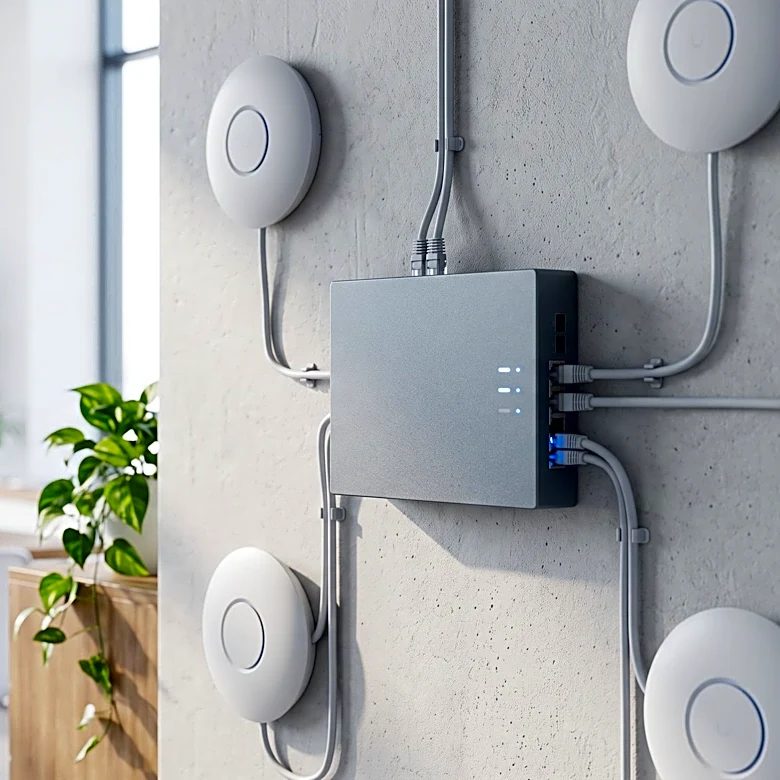
Beyond raw speed, you need to consider latency. Also known as "ping," latency is the response time of your connection—how long it takes a data packet to travel from your computer to a server and back. For activities that require real-time feedback, like online gaming or video conferencing, low latency is more important than massive bandwidth. Anything under 50 milliseconds (ms) is considered good, but competitive gamers and professionals often seek connections under 20ms. Finally, your internet plan is only as good as your router. An old or cheap router can act as a major bottleneck, unable to handle the speeds you're paying for or manage traffic from dozens of connected devices efficiently. If you're paying for a gigabit plan but using a router that's five years old, you're likely not getting the performance you expect. A modern router that supports current Wi-Fi standards is essential to distribute your connection effectively throughout your home.
The Real Math for a Power User Household
So how much speed do you really need? Instead of focusing on one 4K stream, do the math for your household's peak usage. Let’s say at 8 p.m. on a Tuesday, you have: two 4K streams running (~25 Mbps each), one person on a Zoom call (~5 Mbps upload), another gaming online (~5 Mbps upload), plus various background devices. You're now easily using over 50 Mbps for downloads and, crucially, 10 Mbps of dedicated upload bandwidth. A 100 Mbps plan with a 10 Mbps upload cap would be pushed to its absolute limit, leading to buffering and lag. For a family of four with multiple streams and a work-from-home setup, a 300 to 500 Mbps plan is a more realistic baseline for a smooth experience. A gigabit (1,000 Mbps) plan provides comfortable headroom, ensuring that even during peak usage, everyone's connection remains stable and fast.