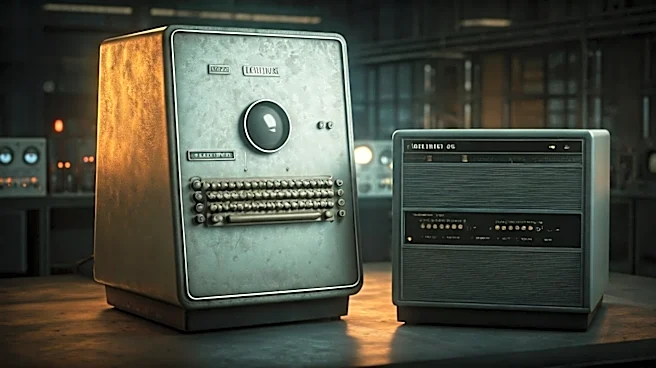












An Undisputed Technological Lead
It’s hard to overstate how far ahead UNIVAC I was. Created by J. Presper Eckert and John Mauchly, the geniuses behind the earlier ENIAC military computer, the UNIVAC (Universal Automatic Computer) was the first machine designed for business and administrative
use. When the U.S. Census Bureau bought the first one in 1951, it officially kicked off the commercial computer industry. Its famous election-night prediction was a public relations masterstroke, cementing the name “UNIVAC” in the American imagination as a synonym for a futuristic electronic brain. The company that owned it, Remington Rand, had a multi-year head start on everyone, including a then-conservative company known for punch-card tabulators and clocks: International Business Machines, or IBM. Remington Rand held the future in its hands. They just didn’t know what to do with it.
The Million-Dollar Science Project
Here lies the “hidden decision.” It wasn’t a single boardroom vote, but a fundamental misunderstanding of their own product. Remington Rand was a successful office equipment company that sold typewriters and filing cabinets. Its executives viewed the UNIVAC not as a revolutionary business tool, but as a bespoke, high-cost scientific instrument. They priced it at over $1 million (more than $10 million today) and marketed it almost exclusively to government agencies and large research institutions. Their sales team, accustomed to selling mechanical devices, was ill-equipped to explain the transformative potential of data processing to corporate America. They saw a handful of high-margin sales, not a scalable mass market. In their minds, only a few dozen organizations in the world would ever need such a powerful, expensive, and complex machine. This colossal failure of imagination was the opening their biggest rival needed.
IBM Sees the Real Market
While Remington Rand treated UNIVAC like a crown jewel to be sold sparingly, IBM, under the leadership of Thomas Watson Jr., saw an entirely different opportunity. Watson Jr. recognized that businesses didn't need the absolute best, most powerful computer; they needed a “good enough” machine that solved everyday problems like payroll, inventory, and accounting. In 1953, IBM launched the IBM 650. It was smaller, less powerful, and less technologically advanced than UNIVAC, but it was also dramatically cheaper and, crucially, designed from the ground up for business applications. IBM didn’t just sell machines; they leased them, provided robust customer support, and trained a generation of programmers and operators. They didn't sell a product; they sold a solution. While UNIVAC’s creators were engineers focused on technological perfection, IBM was a sales-driven organization focused on the customer. By the mid-1950s, IBM was installing hundreds of 650s for every single UNIVAC sold.
The Legacy of a Fumbled Future
The results were swift and brutal. By the end of the 1950s, IBM had captured the market. The name “IBM” replaced “UNIVAC” as the default term for a computer in the business world. Remington Rand, which later merged to become Sperry Rand, spent decades as a distant, struggling competitor in a market it had single-handedly created. The story of UNIVAC’s commercial failure is a foundational cautionary tale in Silicon Valley and business schools everywhere. It proves that technological superiority means little without the right business strategy, market vision, and sales execution. The decision to treat a revolutionary product as a niche scientific gadget instead of a scalable business tool didn't just cost one company its lead; it cleared the path for an empire and defined the corporate hierarchy of the digital age for the next half-century.